

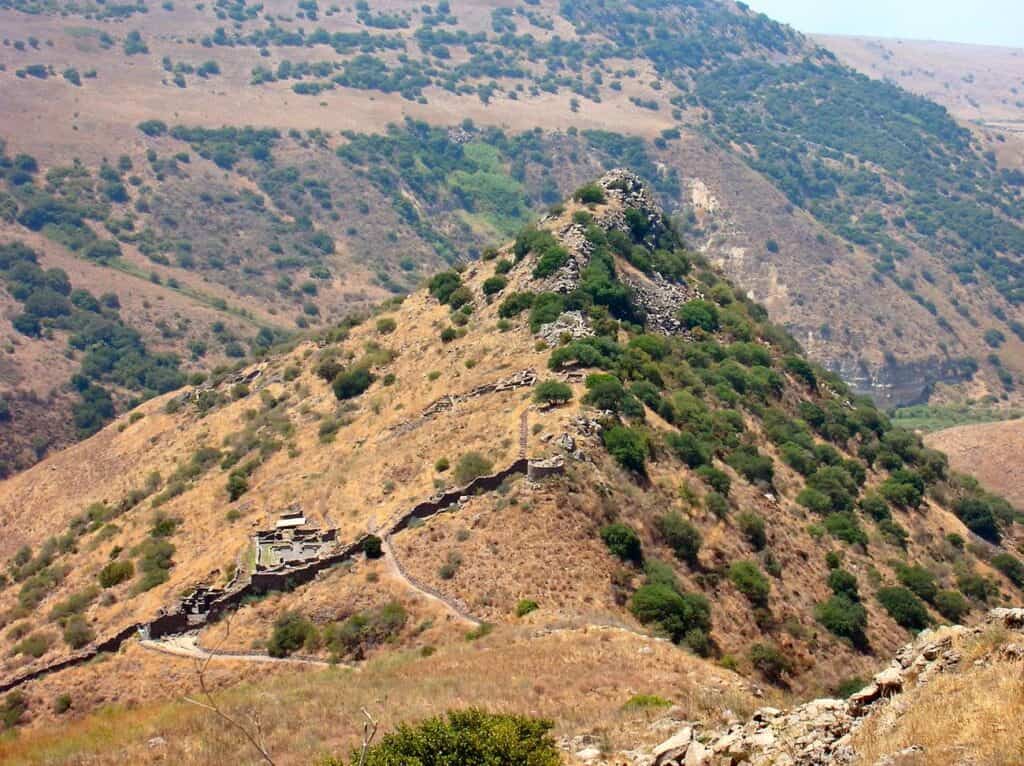
A first-century Jewish town on a ridge shaped like a camel’s back, destroyed by Rome in AD 67 and never rebuilt. Nothing was built on top of it, which makes it the purest first-century town in the country.
Gamla is a town destroyed and abandoned in a single season and never reoccupied. So everything you see belongs to one century. There are no later layers to see past.
The ridge that gives Gamla its name
The name comes from the Hebrew word for camel, and the reason is visible from the overlook. The town sits on a steep spine of rock rising between two ravines, humped in the middle, dropping away sharply on three sides. Only one approach is possible, from a saddle at the eastern end.
That made it defensible and, as it turned out, a trap.
The Roman siege of Gamla in AD 67
When the Jewish revolt against Rome broke out in AD 66, Gamla fortified itself and refused to submit. Josephus (who later became a famous writer and historian) was a commander in Galilee before defecting to the Romans. He describes what happened to Gamla in his account of the war.
Vespasian brought three legions. The first assault broke into the town, and the Roman soldiers, fighting uphill through narrow streets between houses stacked on the slope, were driven back with heavy losses. The siege continued. Eventually a section of the wall was brought down, the legions came through the breach, and the town fell.
Josephus reports enormous casualties, with many of the inhabitants throwing themselves off the cliffs rather than be taken as prisoners and slaves. His numbers are likely exaggerated and should be read with the same caution his Masada account deserves: he was writing for a Roman audience, and ancient historians composed scenes and rounded figures. But still, it is unmistakable that the Jewish town of Gamla fell to the Romans. What the archaeology confirms is a violent, one-time destruction.
What excavation found
Digging began in the 1970s, and the results are unusual in how directly they line up with the written account.
There is a breach in the town wall, in a place consistent with Josephus’s description. Hundreds of ballista stones, the heavy round shot fired by Roman siege artillery, are still lying where they landed. Arrowheads by the thousand. Coins struck in the town during the revolt. Houses that burned and were never cleared.
And a synagogue, built against the eastern wall, in use in the first century. That makes it one of the small handful of synagogues known from before the destruction of Jerusalem, a room where Galilean and Golan Jews gathered during the years the Gospels describe. A place that Jesus himself may have visited.
What the visit is like
Judge the walk realistically before you commit to it. Reaching the town means a steep descent and, more to the point, a steep climb back out, on rough ground with no shade.
The overlook is genuinely worth it on its own. You see the whole ridge, the ravines on both sides, and the shape of the problem the defenders and the Romans each faced. The site is inside a nature reserve, and griffon vultures nest in the cliffs here, circling below eye level while you look down at the town.
Why Gamla belongs on a Golan itinerary
Two reasons, and the second is the one that stays with people.
First, it is a whole first-century Jewish town, in one layer, with a synagogue. If you want to know what the streets and houses and gathering places of Jesus’s world looked like, this is among the clearest pictures available.
Second, it gives the revolt a human scale that Jerusalem cannot. Jerusalem is vast and rebuilt many times over. Gamla is small enough to take in at a glance, and it ended in a few weeks in the summer of AD 67, and then nothing. Standing at the overlook, you are looking at what a Roman decision to make an example of a town actually meant.
Come and See
Why did the people of this ridge choose to fight against Rome?
Hike out to the overlook with us.
| Explore Upcoming Departures | Prepare To Be A Pilgrim |
 |

Sources and Further Reading
- Josephus, The Jewish War, book 4, the ancient account of the siege.
- Jodi Magness, The Archaeology of the Holy Land: From the Destruction of Solomon’s Temple to the Muslim Conquest (Cambridge University Press, 2012).
- Jerome Murphy-O’Connor, The Holy Land: An Oxford Archaeological Guide from Earliest Times to 1700, 5th ed. (Oxford University Press, 2008).
