

And What Detail Did Scholars Say Was Invented?
John describes a pool with five porches. For centuries that was treated as symbolism rather than architecture, because no such pool was known. Then it was excavated, and there were five.
This is one of my favorite stops because it helps us have a clear answer about how much of the Gospel record can be checked with facts on the ground.
What John says about the five porches
The description is specific. “Now there is at Jerusalem by the sheep market a pool, which is called in the Hebrew tongue Bethesda, having five porches” (John 5:2). A man had been ill for thirty-eight years and lay among a crowd of sick people waiting there. Jesus asked him whether he wanted to be made whole, and healed him.
Five porches is an unusual detail. A porch here means a covered colonnade, a roofed walkway on pillars where people could shelter from sun and rain. Public pools in the Roman world were typically rectangular, and a rectangle takes four colonnades. Five made no architectural sense.
Why scholars doubted it
Through the nineteenth century, a number of scholars concluded that the number was symbolic rather than real. Five porches, five books of Moses; a theological point dressed as a description, written by someone who had never seen Jerusalem.
That reading fit a broader argument of the period, which held that John’s Gospel was composed chronologically long after the time of Jesus and geographically a far distance away by someone with little firsthand knowledge of the city.
What excavation found
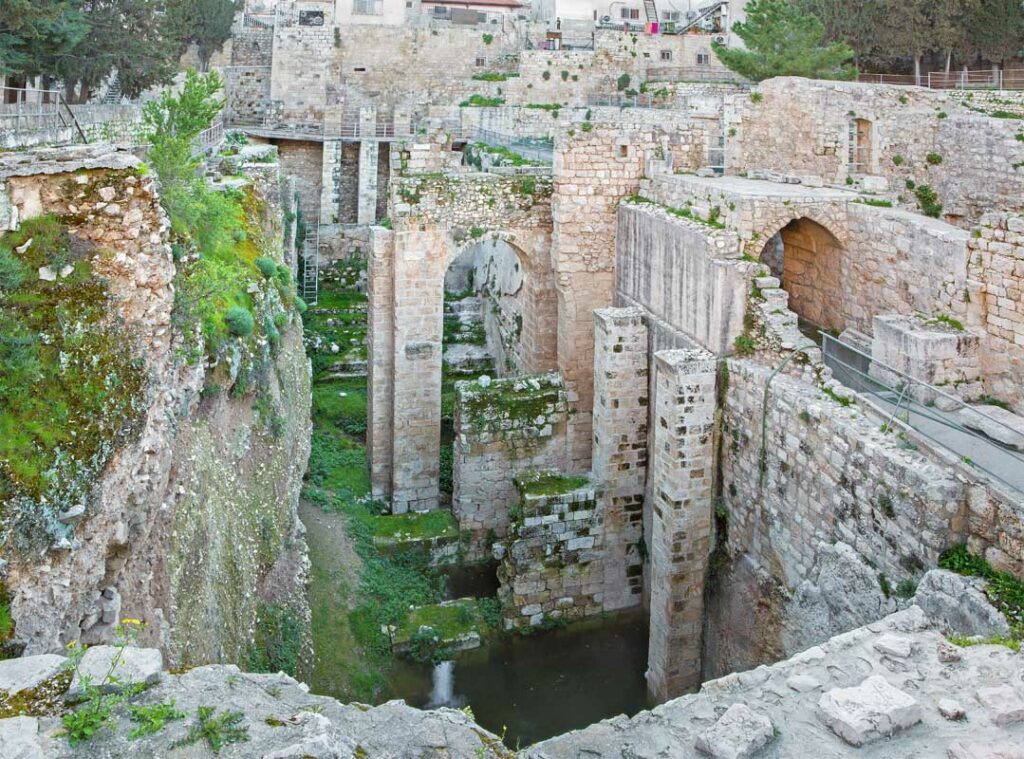
Digging on the site, which lies just inside the Lions’ Gate in the northeast of the Old City, uncovered something no one had predicted.
There were two pools, not one, set side by side and separated by a broad partition of rock. Colonnades ran along the four outer sides, and a fifth ran along the partition dividing the two pools.
Five porches.
Exactly as described, in a configuration nobody would have invented, at a site near the gate through which sheep were brought for temple sacrifice, which is what John means by the sheep market.
This of course does not prove the miracle, and it does not prove the authorship of the Gospel. What it establishes is that the writer knew the specific architecture of a specific pool in Jerusalem, in a form that ceased to exist after the city was destroyed and that modern people did not understand or know about until archaeology intervened. So the writer of the Gospel of John had been there at the Pool of Bethesda, or he learned about it from someone who had.
What else is on the site
The ruins are layered and take a few minutes to sort out. Above and around the pools are remains of a Roman-era healing shrine, complete with small votive offerings left by people seeking cures. After the Roman rebuilding of the city (after AD 70), this place was still associated with healing, under different gods.
Later came a large Byzantine church built over the pools, and after that a Crusader chapel. The result is a deep pit of walls and arches with the two ancient pools at the bottom.
Singing in the Church of St. Anne
Beside the pools stands the Church of St. Anne, built by the Crusaders in the twelfth century over the traditional site of the home of Mary’s parents. It is plain, heavy, and beautiful, and it survived because Saladin, the Muslim leader who reconquered Jerusalem from the Christians in 1187, turned it into a school rather than destroying it. An inscription above the door records that. In the nineteenth century it passed to France, and it is French property today.
The building has extraordinary acoustics. The stone vaulting holds a note for several seconds after the singer stops, so that a group singing in parts hears itself answered by the room.
Every group I bring here sings, and every group is surprised by what happens. People who never sing in public sing in St. Anne’s church. There is often a line of other groups waiting their turn to sing, from a dozen countries. This is pilgrimage at its best.
One practical note: keep it to a few minutes, because others are waiting, and the courtesy is part of the experience.
Come and See
Why did the sick gather at this pool, and what were they hoping for?
Read John 5 with us on site.
| Explore Upcoming Departures | Prepare To Be A Pilgrim |
 |

Sources and Further Reading
- Shimon Gibson, The Final Days of Jesus: The Archaeological Evidence (HarperOne, 2009).
- Jodi Magness, The Archaeology of the Holy Land: From the Destruction of Solomon’s Temple to the Muslim Conquest (Cambridge University Press, 2012).
- Jerome Murphy-O’Connor, The Holy Land: An Oxford Archaeological Guide from Earliest Times to 1700, 5th ed. (Oxford University Press, 2008).
