

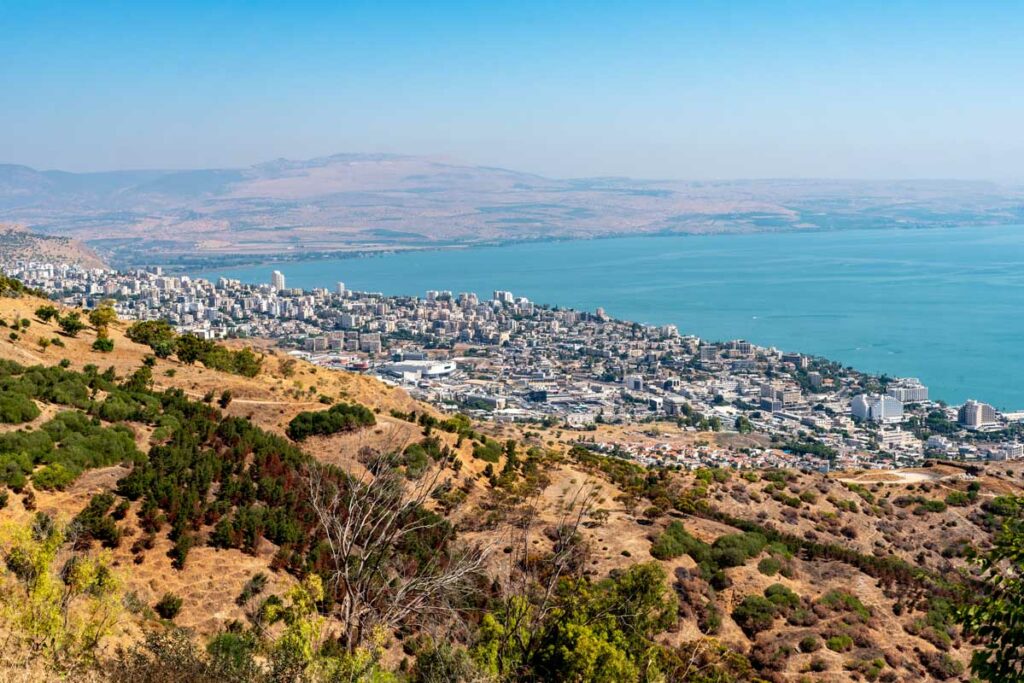
Herod Antipas built Tiberias on a graveyard, and observant Jews avoided it. Centuries later it became the place where the text of the Hebrew Bible was fixed for good.
Most groups sleep in Tiberias, eat in Tiberias, and walk the promenade in Tiberias without hearing much about it. That is a missed opportunity, because the town has one of the strangest arcs in the whole country.
A new capital with a problem
Herod Antipas ruled Galilee during the ministry of Jesus, and around AD 20 he built himself a capital on the western shore of the lake. He named it Tiberias after the emperor who had confirmed him in power, and he built it in the Roman style, with a palace, a stadium, and hot springs nearby.
Then a difficulty surfaced. The site included an old burial ground, and under Jewish law contact with a grave makes a person ritually unclean. Observant Jews would not live there. Josephus records that Antipas had to fill his new city by other means, settling people who had little choice in the matter.
So Tiberias began as a Roman city with a Jewish ruler, in the middle of Jewish Galilee, that observant Jews avoided.
The Gospels and Tiberias
Now notice something in the Gospel record. The lake gets called the Sea of Tiberias (John 6:1; 21:1). Boats from Tiberias appear on the water (John 6:23). The town existed, it was the largest settlement on the shore, and it was a short walk from Magdala and a few miles from Capernaum.
And no Gospel records Jesus entering it.
That silence may mean nothing; the Gospels record a fraction of what happened. It may also fit a pattern. His ministry ran through the fishing villages and the farm towns rather than the administrative capitals, and Antipas is the man who had John the Baptist killed and who later wanted to see Jesus perform a sign. Whatever the reason, the record we have keeps the ministry outside this particular city.
What happened next
Here is the turn, and it is a remarkable one.
After the destruction of Jerusalem in AD 70, and especially after the second Jewish revolt sixty years later (AD 132–135), Jewish life in the land moved north into Galilee. The ritual objection to Tiberias was eventually resolved, and the town filled with scholars. The high court relocated here. Great rabbis taught here and were buried here. The Jerusalem Talmud was brought to completion in this region, much of the work done right in this very city.
And then here is the piece that matters most for anyone who reads a Bible.
Hebrew was written without vowels. For centuries the correct reading of the consonants was carried by memory and by careful oral transmission from teacher to student. Between roughly the eighth and tenth centuries, scholars in Tiberias developed a full system of marks to record the vowels, the accents, and the phrasing of the text, and they applied it to the Hebrew Bible with extraordinary precision.
That system is the one still in use. When you open a Hebrew Bible today, or when a translator works from the Hebrew text, the vocalized text being read was fixed by scholars working in this town on this shore.
What to see in Tiberias
The ancient city lies mostly south of the modern center. At the hot springs there is a synagogue floor from the fourth century with a striking mosaic, and the springs themselves still run hot. The tomb of Maimonides, the great medieval scholar and physician, is in the city and draws steady visitors. Tiberias is counted as one of the four holy cities of Judaism, alongside Jerusalem, Hebron, and Safed.
Why Tiberias is worth explaining to a group
Because of the shape of the story.
A client king built a showpiece city to flatter an emperor, on ground that made it unusable to the very people he ruled. The teacher whose ministry filled the shoreline seems never to have set foot in it. And eight centuries later, in that same city, scholars did the painstaking work that preserved the pronunciation of the Hebrew scriptures for every generation since.
Hearing that over dinner, with the lake dark in front of them, changes what the town is to a group for the rest of the trip.
Come and See
How did a Roman city on this shore reshape the world the disciples lived in?
Let us trace the names together.
| Explore Upcoming Departures | Prepare To Be A Pilgrim |
 |

Sources and Further Reading
- Josephus, Antiquities of the Jews, book 18, on the founding of Tiberias.
- Jodi Magness, The Archaeology of the Holy Land: From the Destruction of Solomon’s Temple to the Muslim Conquest (Cambridge University Press, 2012).
- Jerome Murphy-O’Connor, The Holy Land: An Oxford Archaeological Guide from Earliest Times to 1700, 5th ed. (Oxford University Press, 2008).
