

When and How Was It Found?
For centuries pilgrims were shown a small Byzantine pool. Then a sewer repair crew broke through some steps, and the real pool turned out to be far larger and in the right century.
This stop closes two loops at once. It is near to where Hezekiah’s Tunnel comes out, and it is where a blind man was sent to wash. It is also one of the newest major discoveries in Jerusalem, and the story of how it was found is worth telling.
Where the water goes
Start with the plumbing, because everything follows from it. The Gihon Spring rises at the foot of the eastern slope of the City of David. Around 701 BC, Hezekiah’s workers cut a tunnel through the ridge to carry that water to a reservoir inside the city walls, safe from a besieging army.
That reservoir is the Pool of Siloam. Isaiah, writing in the same era, speaks of the waters of Shiloah that go softly (Isaiah 8:6). The water still arrives, by the same route, today.
The pool that was shown for centuries
Where Hezekiah’s tunnel exits, there is a modest pool with a few columns and some later stonework around it. This was built in the fifth century after Christ, during the Byzantine period, when a church was raised over the site to mark the healing in John’s Gospel. This is not the Pool of Siloam.
For roughly fifteen hundred years, that small pool was what pilgrims were shown as the Pool of Siloam, and generations of visitors stood there and read John 9. It marks the right area. It is several centuries too late to be the pool in the story.
What the repair crew found
In 2004 a crew working on a damaged sewer line a short distance downhill cut into the ground and exposed a run of ancient stone steps. Work stopped and archaeologists were called in.
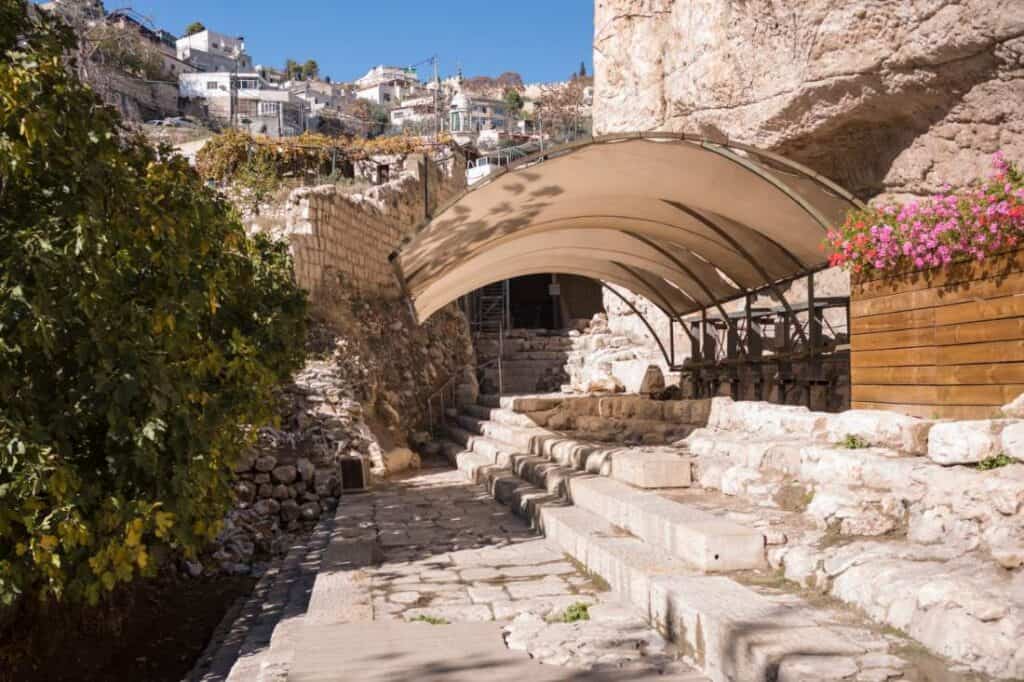
What emerged was a monumental pool from the Second Temple period, far larger than the Byzantine one, with broad flights of steps descending in tiers with landings between them, built on a scale suited to crowds rather than to a few people drawing water.
Excavation has continued in stages, complicated by the fact that much of the pool lies under land in other hands. In recent years the work has expanded, and more of the pool has come to light.
Alongside it, archaeologists have been uncovering the stepped street that ran from the pool up the valley toward the temple. Pilgrims coming into Jerusalem arrived at the bottom of the city, and this was the road up.
Why the size matters
A great many pilgrims came to Jerusalem for the festivals, and all of them needed to be ritually pure before entering the temple courts. A large stepped pool at the lowest point of the city, at the foot of the road that leads up to the temple, fits that need well, and many scholars read it that way.
This pool seems to have functioned as a ritual bath and as a reservoir. And it is at the bottom, or the start, of the pilgrim route.
Now read the healing with that in mind. A man born blind is given sight in stages: Jesus makes clay, anoints his eyes, and sends him, from much further up slope at the temple stairs, to come down here to wash in the pool of Siloam (John 9:6–7). John pauses to tell his readers that the name means sent. The man walks down through the city to the great public pool at the bottom, washes in front of whoever happened to be there, and comes back seeing.
Come and See
Why did a blind man have to walk across the city to wash in this pool?
Follow that path with us.
| Explore Upcoming Departures | Prepare To Be A Pilgrim |
 |

Sources and Further Reading
- Shimon Gibson, The Final Days of Jesus: The Archaeological Evidence (HarperOne, 2009).
- Jodi Magness, The Archaeology of the Holy Land: From the Destruction of Solomon’s Temple to the Muslim Conquest (Cambridge University Press, 2012).
- Jerome Murphy-O’Connor, The Holy Land: An Oxford Archaeological Guide from Earliest Times to 1700, 5th ed. (Oxford University Press, 2008).
- Ronny Reich, Excavating the City of David: Where Jerusalem’s History Began (Israel Exploration Society, 2011).
