

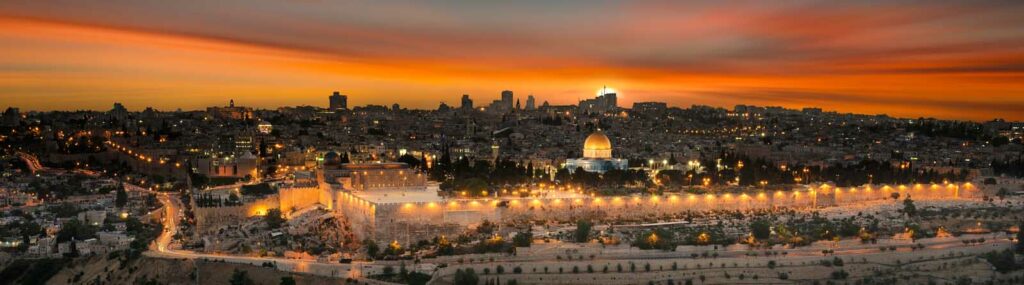
A Visitor’s Guide
Jerusalem’s walled city covers about a third of a square mile and holds four communities, seven working gates, and a street plan that will get you lost on the first day. Here is how it fits together.
The Old City is smaller than nearly everyone expects. You can cross it on foot in about twenty minutes, if you do not get lost, which you will. Knowing the four quarters and a few landmarks turns that from frustrating into enjoyable.
The Ottoman walls of the Old City
The walls you walk beside are Ottoman, built in the 1530s and 1540s under Suleiman the Magnificent, which makes them younger than a good many cathedrals in Europe. They follow earlier lines in places and depart from them in others, which is why parts of ancient Jerusalem, including the City of David and the traditional Mount Zion, now sit outside the walls.
Seven gates are in use, and one is not. Jaffa Gate on the west is the main tourist entrance. The New Gate on the north was built in 1887 and gives access to the Christian Quarter neighborhoods. Damascus Gate on the north is the grandest and the busiest. Herod’s Gate, also on the north and not as busy, mostly serves the Muslim Quarter neighborhoods. Lions’ Gate on the east opens toward the Mount of Olives. Just a bit further along the wall heading south is the Golden Gate on the eastern wall. It faces the Mount of Olives and is sealed with stone. The Dung Gate on the south is the closest to the Western Wall. Zion Gate on the southwest is pocked with bullet holes from the fighting of 1948, and worth a look.
How the quarters came to be
One thing to know at the outset: the tidy four-quarter map is more recent than it looks. Communities always clustered around their holy places, but the crisp division into four labeled zones was formalized by European surveyors in the nineteenth century, and it flattens a city that was, and is, more mixed than the map suggests. Use the quarters as a way to navigate rather than as a description of who lives where.
The Muslim Quarter
The largest and most populous, filling the northeast. Its main streets are covered markets, loud and crowded and full of spice, bread, fabric, sweets, and phone cases. The Via Dolorosa runs through it, and the route to the Temple Mount passes along its edge.
This is where most pilgrims feel the Old City most strongly. It is also where most pilgrims get lost, because the streets bend and the covered sections hide the sun.
The Christian Quarter
The northwest, built around the Church of the Holy Sepulchre. Dozens of churches, monasteries, and hospices belonging to many communions crowd into a small area, along with shops selling olive wood, icons, and pilgrimage goods.
Look for the Muristan, an open square with a fountain, which sits on ground that has served pilgrims for a thousand years and gives you a place to stand (or sit) still without the crush of people.
The Armenian Quarter
The smallest, in the southwest, and the quietest by a wide margin. Much of it lies behind walls and closed gates, because it is a residential compound as much as a neighborhood.
The Armenian presence here is very old. Armenia adopted Christianity as a state religion early in the fourth century, and Armenians have maintained a community in Jerusalem since not long after. The Cathedral of St. James is the center of it, open to visitors only during services, and the sound of that liturgy is unlike anything else in the city.
The Jewish Quarter
The southeast, closest to the Western Wall, and the most recently rebuilt. The quarter was destroyed in the fighting of 1948 and lay in ruins under Jordanian control until 1967, after which it was rebuilt.
That reconstruction had an unexpected benefit. Before the new buildings went up, archaeologists were able to excavate, and what they found is now on display beneath and among the houses: Hezekiah’s Broad Wall, the Byzantine Cardo with its columns, and the burnt remains of a priestly mansion destroyed in AD 70.
The quarter is open, bright, and easy to walk, which makes it a good place to explore.
How to find your way in the Old City
Four practical rules.
The Temple Mount is east and downhill from most of the Old City. When you are turned around, head downhill toward it and you will reach a landmark you recognize.
The city is small. Being lost here means being a few hundred yards from where you meant to be, and shopkeepers will point you along cheerfully.
Wear proper shoes with good support and grip. The stone is worn smooth and slick, there are steps everywhere, and rain makes it worse.
Go in the evening if you can. After the day groups leave, the streets open up, shops are still trading, and the Old City becomes a working neighborhood again rather than a crowd.
Shopping and haggling in the Old City
Haggling is expected in the markets and is meant to be friendly rather than adversarial. Ask the price, offer well below it, settle somewhere in between, and stay good-humored throughout. Walking away is a normal part of the process and nobody takes offense. If you have no intention of buying, say so pleasantly rather than bargaining for sport.
Fixed-price shops exist too, and the modern city has plenty of them if bargaining is not for you.
Come and See
How might walking all four quarters in a single day change the way you understand the Old City of Jerusalem?
Let us walk them together.
| Explore Upcoming Departures | Prepare To Be A Pilgrim |
 |

Sources and Further Reading
- Simon Sebag Montefiore, Jerusalem: The Biography (Knopf, 2011).
- Jerome Murphy-O’Connor, The Holy Land: An Oxford Archaeological Guide from Earliest Times to 1700, 5th ed. (Oxford University Press, 2008).
