

What to Know Before You Go
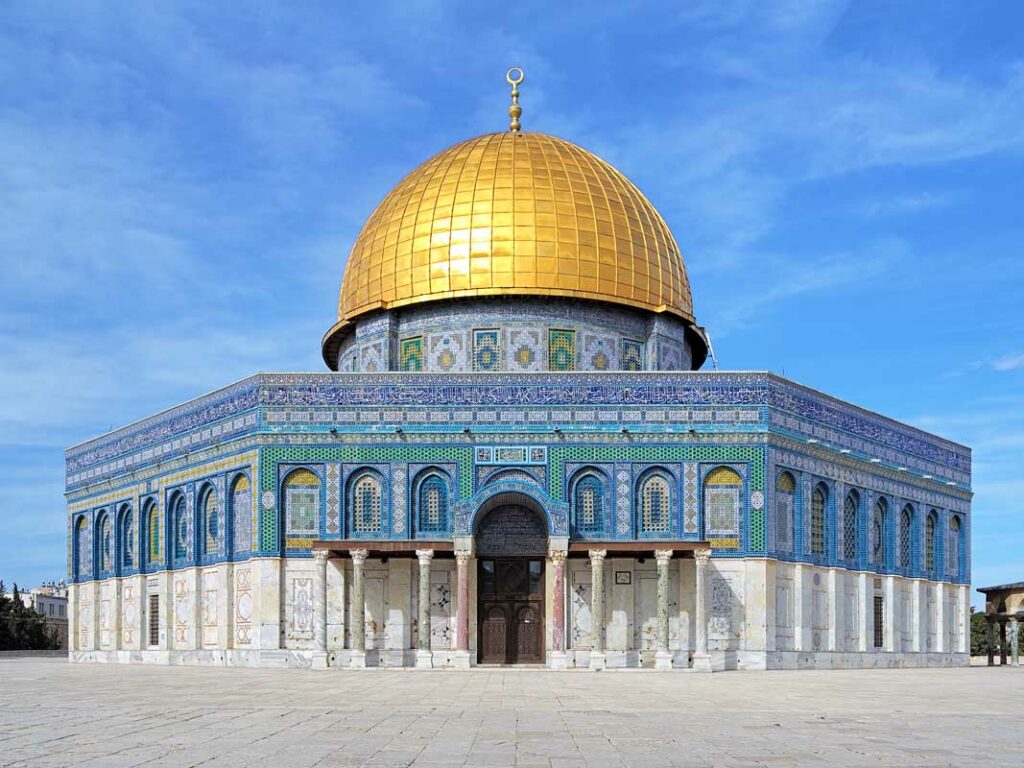
The golden dome you photograph from every rooftop in Jerusalem is a shrine built in AD 691, standing over a rock that three faiths connect to their own beginnings. Here is what it is, and the rules for going up.
Every visitor to Jerusalem sees this building a dozen times before setting foot on the platform. It appears in every panorama, every postcard, every view from the Mount of Olives. Then, on one early morning, you join the line at a wooden bridge beside the Western Wall plaza and go up as a pilgrim of faith.
What the building is
The Dome of the Rock was completed in AD 691, under the Umayyad caliph Abd al-Malik. That makes it one of the oldest Islamic buildings still standing anywhere, and it has been rebuilt and restored many times since.
It is a shrine rather than a mosque. The congregational mosque on the platform is al-Aqsa, the building with the silver-grey dome at the southern end. The entire enclosure, which Jews call the Temple Mount, is known in Islam as al-Haram al-Sharif, the Noble Sanctuary, and it is the third holiest place in Islam after Mecca and Medina.
The plan is an octagon wrapped around a circle, with the dome resting on the inner ring of columns. Under that dome, and the whole reason for the building, is a large mass of exposed natural bedrock.
Two details are worth knowing even though you view them from outside. The interior carries long Arabic inscriptions that are among the earliest dated Quranic texts anywhere. And the golden covering on the dome is modern; the current gilding was done in the 1990s.
Why the rock beneath the Dome matters to three faiths
Three traditions meet on that outcrop, and understanding all three makes the visit far richer than treating the platform as somebody else’s holy place you are permitted to cross.
The oldest traditions associate the creation of the world with this rock, holding that the tree of life grew there and that the four rivers of Eden flowed from this center point of the world to the quarters of the earth.
In Jewish tradition the rock is connected with Mount Moriah, where Abraham was sent to offer Isaac (Genesis 22), and Chronicles states that Solomon built the temple in Mount Moriah (2 Chronicles 3:1). Most scholars place the temple sanctuary at or very near this outcrop, though the question has more than one serious answer.
In Islamic tradition the site is associated with the Night Journey, in which Muhammad was carried to the farthest place of prayer and from there ascended. That association is why a shrine was built here rather than anywhere else in the city.
And in the Crusader period the building served for most of a century as a Christian church, called the Temple of the Lord.
One rock. Three claims on the same stone, running back four thousand years, still unresolved. That is a good deal of what makes Jerusalem what it is.
Dome of the Rock visiting hours, dress, and rules
Non-Muslim visitors enter through one designated route, the wooden bridge that rises from the Western Wall plaza. Everyone passes a security check. Visiting hours for non-Muslims are limited, usually in the morning, and the platform is closed to visitors on Fridays and Islamic holidays. Hours change, and they change without notice, which is why groups go early.
Non-Muslim visitors may walk the platform and view the buildings from outside. Entry into the Dome of the Rock and into al-Aqsa is not permitted for non-Muslims.
Dress is stricter here than anywhere else on the itinerary. Cover to the wrists and to the ankles, men and women alike, with shoulders and chest fully covered. Robes are available to borrow at the entrance if what you have on falls short. Wear what you plan to tour in that day and borrow if needed.
Prayer by non-Muslims on the platform is prohibited, and so is bringing religious texts or objects. That includes reading scripture aloud, singing, kneeling, or anything that reads as a religious act. The authorities who administer the site watch for it closely.
Take that rule seriously and take it graciously. You are a guest in a place of worship belonging to someone else, under an arrangement that has been negotiated with great difficulty and is easily disturbed.
Remember, this has been an Islamic holy site for nearly fourteen hundred years, while the various Jewish temples that once stood at this location account for roughly eight hundred years of its history.
What to look at while you are up there
The platform is large, open, and unexpectedly calm. Cypress trees, paving, arcades on the raised inner terrace, small domes and fountains scattered across it.
Walk to the eastern edge and look across the Kidron at the Mount of Olives, which reverses the view you had from the Mount of Olives. Look at the scale of the retaining walls from above. Notice the arcades at the top of the steps onto the inner platform. And take time with the exterior tilework of the Dome itself, which is Ottoman work replacing the original mosaics, and is spectacular in early light.
I ask groups to walk this platform slowly and mostly in silence, which satisfies the rule and also happens to be the right way to be here.
There is a presence and significance to be felt here like nowhere else, if the pilgrim is open to it.
Come and See
Why is this area sacred to so many? And how will you be different because you visited?
Let us prepare for it together.
| Explore Upcoming Departures | Prepare To Be A Pilgrim |
 |

Sources and Further Reading
- Oleg Grabar, The Dome of the Rock (Harvard University Press, 2006).
- Jerome Murphy-O’Connor, The Holy Land: An Oxford Archaeological Guide from Earliest Times to 1700, 5th ed. (Oxford University Press, 2008).
- Leen Ritmeyer, The Quest: Revealing the Temple Mount in Jerusalem (Carta, 2006).
