

The capital of Galilee sat an hour’s walk from Nazareth and was being rebuilt from the ground up during Jesus’s childhood. The New Testament never mentions it, and that silence is worth thinking about.
Sepphoris is the great what-if of the Gospels. It is close to his boyhood home of Nazareth, it is important, it was under construction during exactly the right years, and no Gospel writer names it once.
The city next door
Sepphoris sits on a hill about four miles from Nazareth. That is an hour’s walk on foot, less for someone used to walking, and the two places are in sight of the same ridgelines.
When Herod the Great died in 4 BC, revolt broke out across the country. Jewish Sepphoris rose in revolt, and Rome answered hard: the city was taken and burned, and its people were sold into slavery. Herod Antipas then rebuilt it as the non-Jewish capital of Galilee, and Josephus calls the result the ornament of all Galilee.
So during the years when Jesus was growing up in Nazareth, a Roman-style city was being built from the ruins up, four miles away, with everything that implies: stonecutters, carpenters, plasterers, roadbuilders, master masons, and steady demand for skilled hands.
The question everyone asks
Did Joseph and Jesus work there?
The word the Gospels use for their trade means a builder or craftsman working in wood and stone, rather than a furniture maker in a shop. Nazareth was a small village of perhaps a few hundred people, which could not have supported a full-time building trade on its own. A major construction project four miles away is exactly where a builder from Nazareth would find work.
That reasoning is sound, and it is reasoning rather than evidence. No text places them there. No inscription names them. What can be said is that the possibility is entirely plausible and entirely unproven, and anyone who tells you otherwise in either direction is going beyond what we know.
The silence itself is interesting. Sepphoris was the largest and most important place in Galilee, and the Gospels put the ministry in Capernaum, Bethsaida, Chorazin, Nain, and Cana. Villages, not capitals. Whether that was deliberate or simply how the work unfolded, the record consistently points away from the seats of power to the ordinary places of Jewish life.
What you see at Sepphoris today
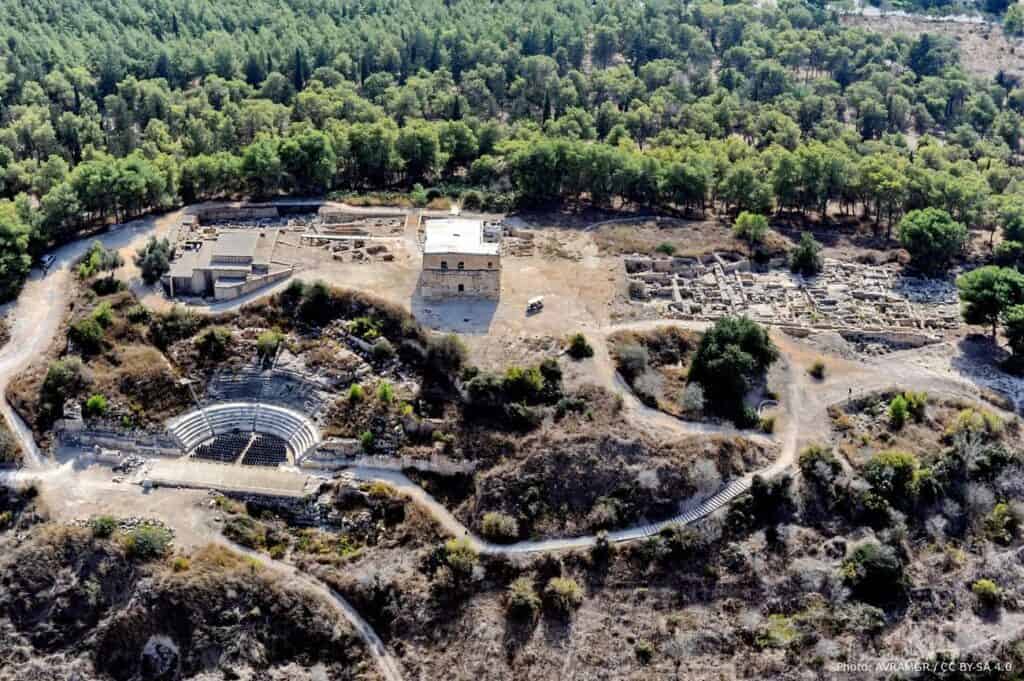
The site is rich, and most of what survives is later than the Gospels, which pilgrims should know going in.
A theater cut into the hillside, seating several thousand. Its date is debated: some place it in the time of Antipas, others later in the Roman period.
A grand Roman villa with a dining room floor from the third century, showing scenes from the life of Dionysos. In the border is the face of a woman, rendered in stone with astonishing subtlety, which has been called the Mona Lisa of the Galilee since the mosaic came to light in 1987. It is the finest mosaic in Israel and worth the visit by itself.
A colonnaded street with the ruts of cartwheels still worn into the paving. A large mosaic showing the Nile in flood. A synagogue floor from the fifth century. And a water system with an enormous rock-cut reservoir.
The other reason it matters
Long after the Gospel period, Sepphoris became a center of Jewish scholarship. Around AD 200 the head of the Jewish community moved here, and the Mishnah, the first great written collection of Jewish oral law, was brought to completion under his direction. Much of the tradition that shapes Judaism to this day was organized on this hill.
Christian tradition also connects the town with Mary’s parents, and a church commemorating them stands on the site.
Sepphoris as a center of Jewish learning
Pilgrims often imagine Nazareth as isolated, a backwater cut off from the wider world, with Jesus growing up in a village that knew nothing of Rome. The hill at Sepphoris takes that apart. Four miles from His home was a city with a theater, Greek spoken in the streets, imperial architecture, and Roman officials. He grew up within a morning’s walk of all of it.
That does not tell us that Jesus went. It tells us that the world of the Gospels was not a sealed village world, and that the choice to teach in fishing towns rather than in the capital was a choice made in full view of the alternative.
Come and See
Why does a large city an hour’s walk from Nazareth change how we picture the young Jesus?
See the mosaics and judge for yourself.
| Explore Upcoming Departures | Prepare To Be A Pilgrim |
 |

Sources and Further Reading
- Josephus, Antiquities of the Jews, book 18, and The Jewish War, book 2, on Sepphoris under Herod Antipas.
- Jodi Magness, The Archaeology of the Holy Land: From the Destruction of Solomon’s Temple to the Muslim Conquest (Cambridge University Press, 2012).
- Jerome Murphy-O’Connor, The Holy Land: An Oxford Archaeological Guide from Earliest Times to 1700, 5th ed. (Oxford University Press, 2008).
- Rebecca Martin Nagy, Carol L. Meyers, Eric M. Meyers, and Zeev Weiss, eds., Sepphoris in Galilee: Crosscurrents of Culture (North Carolina Museum of Art, 1996).
