

Where the Parables Make Sense
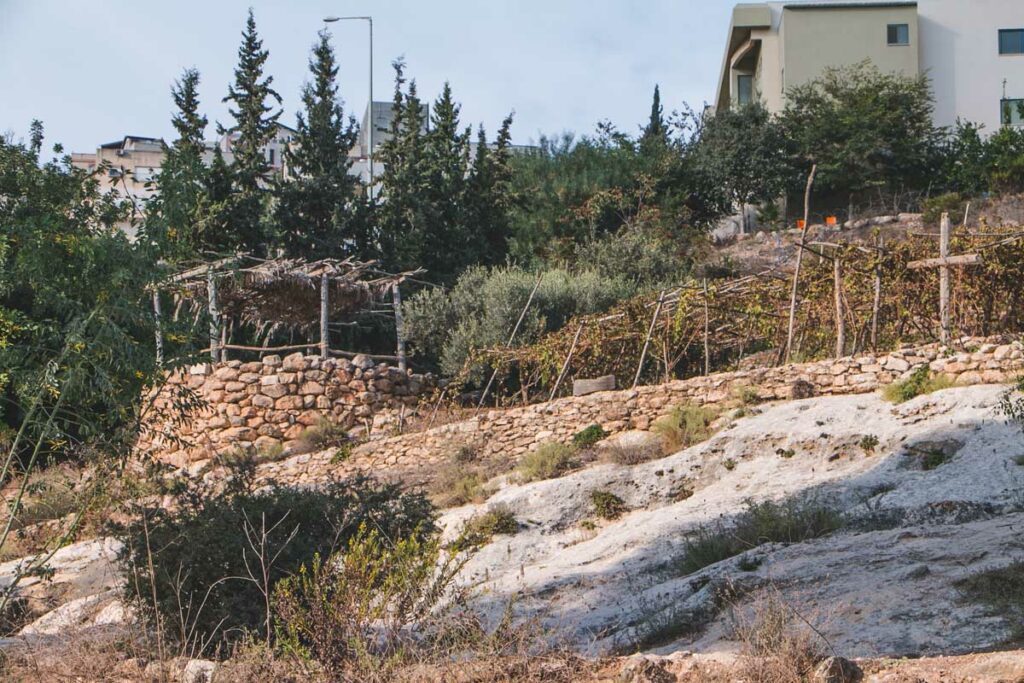
A surviving parcel of ancient farmland inside the modern city, with terraces, a rock-cut winepress, and a watchtower. Walk it and half a dozen parables stop being metaphors and become descriptions.
Of all the stops on a Galilee itinerary, this is the one pilgrims thank me for most often, and it is the one they expect least. A reconstructed farm sounds like a theme park. What it turns out to be is the best classroom in the country.
Why the land matters
The site sits on ground belonging to the Nazareth Hospital, and it survived undeveloped while the city grew around it. When the parcel was studied, what came to light was a working farm in Nazareth from the time of Jesus: agricultural terraces cut into the slope, a winepress carved into the bedrock, cisterns, an irrigation system, quarrying, and the base of a watchtower.
Those features are ancient. That distinction matters and the site is careful about it. The buildings you walk through are reconstructions, raised using period methods and materials. The terraces and the winepress in the ground beneath them are the real thing, on the hillside of the village where Jesus grew up.
The site opened to visitors in 2000.
What you walk through
Interpreters in period dress work the site. There are olive and grape terraces, an olive press with its stone weights, the winepress with its treading floor and collecting vat, a threshing floor, a shepherd with sheep, a carpentry workshop, a village house, and a reconstructed synagogue.
It takes about ninety minutes, most of it outdoors and on uneven ground.
The parables Nazareth Village makes clear
Here is the reason to go, and it is worth being specific.
Stand at the edge of a terraced field and the parable of the sower reveals itself. You can see the beaten path along the terrace edge where seed would fall and be trodden, the thin soil over bedrock where the sun would scorch a seedling, the thorns at the untended margins, and the good ground in the middle (Matthew 13:3–8). Those four soils are four places on one small field, all visible at once. It stops being an allegory of four kinds of people and becomes what a farmer sees on an ordinary morning.
The vineyard parable does the same. A man planted a vineyard, hedged it, dug a winepress in it, and built a tower (Matthew 21:33). All four are here, in the ground: the terrace wall, the press cut into the rock, the tower base. Jesus was describing standard equipment, and His hearers could picture every piece.
Inside the house, a single small oil lamp shows why nobody would light one and hide it under a vessel, and why a woman would sweep the whole floor for a lost coin (Luke 15:8). The room is dark, the lamp is weak, and the floor is packed earth.
And watching an olive press work, with its enormous stone weight bearing down until the oil runs, prepares pilgrims for Gethsemane later in the trip better than any explanation given at the garden itself.
Stunningly, an ancient winepress was discovered here. I am convinced that Jesus knew this farm and that he spent time joyously with neighbors, family, and friends, stomping the grapes in this winepress at harvest season. And why not? For a community so exceedingly small, and for an activity that was so communally shared, I can’t imagine anything but that Jesus grew up knowing this farm intimately. And his experiences here deeply influenced the teaching and parables that he shared.
When to visit Nazareth Village on a tour
Most pilgrims come to the Holy Land wanting to see the great sites, and those are worth seeing. What they usually lack is the ordinary background: how food was grown, how a house worked, how much labor stood behind a jar of oil. The teaching of Jesus is built almost entirely out of that background. He talked about seeds, soil, lamps, bread, sheep, wine, wages, and doors, to people who handled those things daily.
Spend ninety minutes in this location and Jesus and his teachings come alive. I have had pilgrims tell me months later that this was the stop that changed how they read the Gospels.
Come and See
How might watching an olive press work change what Gethsemane means to you?
Spend an unhurried hour with us.
| Explore Upcoming Departures | Prepare To Be A Pilgrim |
 |

Sources and Further Reading
- Jodi Magness, Stone and Dung, Oil and Spit: Jewish Daily Life in the Time of Jesus (Eerdmans, 2011).
- Jerome Murphy-O’Connor, The Holy Land: An Oxford Archaeological Guide from Earliest Times to 1700, 5th ed. (Oxford University Press, 2008).
