

Two Sieges, Eight Centuries Apart
A wall twenty-three feet thick, thrown up in a hurry against the Assyrians, with the demolished houses still visible beneath the stones. And a basement that burned in AD 70, with the spear still leaning in the corner.
Hezekiah saw an Assyrian army coming and built a wall in time. Eight centuries later, a family living a few streets away saw a Roman army coming and did not survive. One excavation in the Jewish Quarter uncovered both, and a visitor can walk between them in a few minutes.
Why the Jewish Quarter could be dug at all
The quarter was wrecked in the fighting of 1948 and lay in ruins for nineteen years. When rebuilding began after 1967, archaeologists were given the chance to excavate before new foundations went in.
Nahman Avigad directed that work from 1969 to 1982, and his findings changed what we know about ancient Jerusalem. Much of what he uncovered was left in place and built into the new neighborhood, which is why you come upon an eighth-century wall in the middle of a modern plaza.
Hezekiah’s Broad Wall
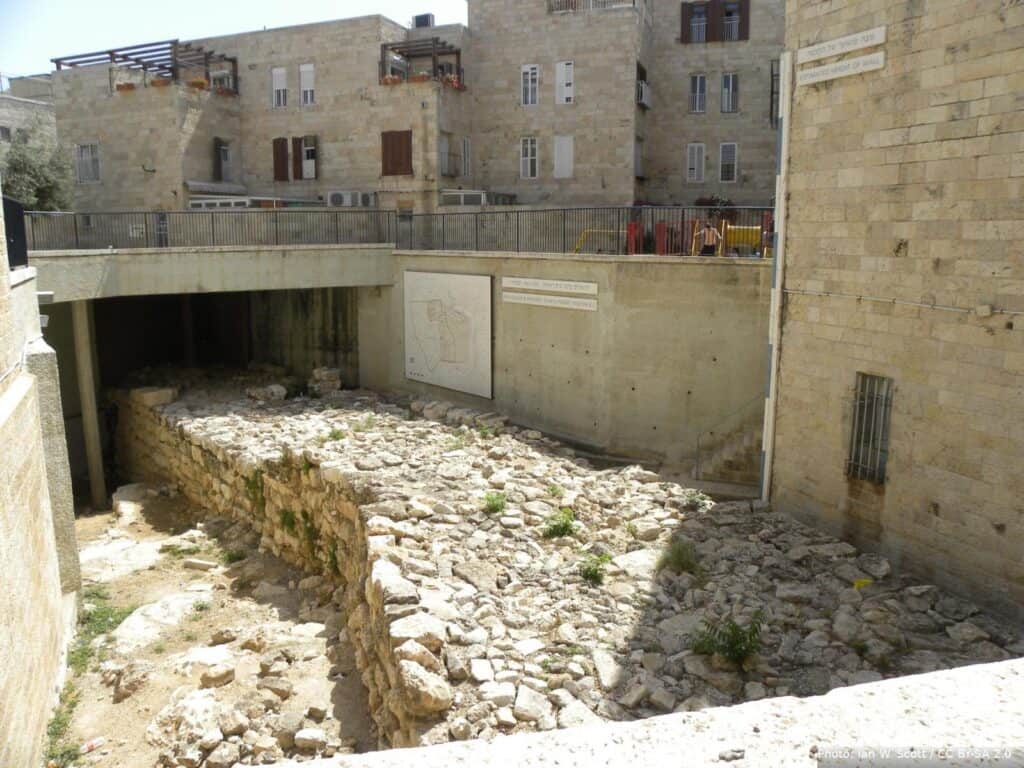
In an open plaza between apartment buildings runs a stretch of massive stone wall, about twenty-three feet thick, preserved along roughly two hundred feet of its length.
The wall dates to around 700 BC. Jerusalem had spread onto the western hill, probably swollen by refugees after the northern kingdom fell to Assyria. All these new people could not fit inside the existing walls of Jerusalem. With an Assyrian army coming, Hezekiah had to enclose the new district fast.
Now look at the base of the wall, because there is a surprising detail there. Underneath the stones are the remains of houses. The builders ran the wall straight through a lived-in neighborhood and demolished whatever stood in the way.
Isaiah, in the same city in the same years, describes exactly that: “And ye have numbered the houses of Jerusalem, and the houses have ye broken down to fortify the wall” (Isaiah 22:10). The prophet’s complaint and the archaeologist’s findings describe one event.
The name comes from Nehemiah, who repaired the fortifications generations later and mentions “the broad wall” (Nehemiah 3:8).
The Burnt House and the fall of AD 70
A short walk away, down a flight of stairs beneath a modern building, is a basement.
Avigad’s team reached that basement in 1970. They found small rooms with a kitchen, stone vessels, ovens, and grinding stones, all under a thick layer of ash with charred roof beams collapsed on top. Coins scattered across the floor ran up to the fourth year of the Jewish revolt against Rome, which is AD 69. This house burned when the city fell in AD 70.
Two finds make the room unforgettable. A spear stood leaning against the wall in a corner, left where somebody set it. And near a step in the doorway lay the arm bones of a young woman who did not get out.
A stone weight in the debris carries an inscription naming the family of Kathros. A rabbinic lament names that same family among the priestly houses of the temple’s last generation who used their position badly. If this was their home, then a family remembered by name for abusing power lost that home in the fire along with everyone else in the city.
The mansions next door
Around the corner, the same excavation uncovered the homes of the wealthy priestly families: large houses with mosaic floors, painted plaster walls, imported tableware, and ritual immersion baths cut into the rock beneath them. Several are open to visitors.
Walking through them tells you something the Gospels assume and never explain. The men who questioned Jesus lived in houses like these, up on the hill, looking down across the valley at the temple. The distance between that quarter and a Galilean fishing village was more than geographic.
Why the two sites belong together
In a matter of minutes you can see some of the most consequential threats Jerusalem has ever experienced.
Two threatened cities, eight hundred years apart, in one quarter of one city.
In the first, Jerusalem saw the danger coming and built, and the city survived that siege. In the second, Jerusalem also saw the danger coming, and this time the walls did not hold.
Come and See
Why did a king widen the city wall, and what happened in the house that burned?
See them both with us.
| Explore Upcoming Departures | Prepare To Be A Pilgrim |
 |

Sources and Further Reading
- Nahman Avigad, Discovering Jerusalem (Thomas Nelson, 1983).
- Nahman Avigad, “Jerusalem in Flames — The Burnt House Captures a Moment in Time,” Biblical Archaeology Review 9, no. 6 (1983).
- Hillel Geva, ed., Jewish Quarter Excavations in the Old City of Jerusalem, Conducted by Nahman Avigad, 1969–1982 (Israel Exploration Society, 2000).
- Amihai Mazar, Archaeology of the Land of the Bible: 10,000–586 B.C.E. (Doubleday, 1990).
