

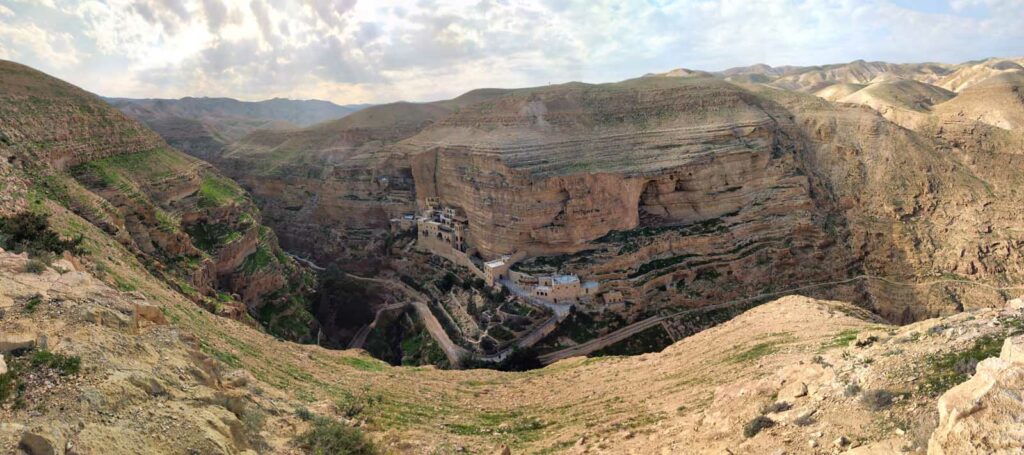
A twenty-mile band of bare chalk hills between Jerusalem and the Dead Sea, close enough to the city to walk into and empty enough to disappear in. Scripture keeps sending people here.
To experience the overlook above Wadi Qelt takes about ten minutes and changes how pilgrims read a great deal of the Bible. Most people picture wilderness as sand dunes or forest. What is in front of you is neither: pale folded hills with almost nothing growing on them, cut by deep dry canyons, running down and away from Jerusalem to gather into the wastes of the Dead Sea.
Note: as of November 2025 when I last attempted to visit, Israeli settlers have blocked access to this location.
Why the Judean wilderness is desert
The reason is simple and it explains the whole geography of the country.
Weather comes off the Mediterranean from the west. It rises over the central hills, cools, and drops its rain on Jerusalem and the ridge. By the time the air crosses the watershed and starts down the eastern slope, it has little moisture left and it is warming as it descends. Within a few miles the rainfall collapses. Near the Dead Sea it is a couple of inches a year.
So Jerusalem sits at the edge of a cliff of climate. Walk east out of the city and within an hour or two you are in country where nothing lives without a spring. That closeness is the important part: the wilderness was never far away.
Wadi Qelt and the Monastery of St. George
Wadi Qelt is the canyon that runs from near Jerusalem down to Jericho, and it is the classic place to see all of this.
A spring keeps a thread of water in the bottom of the gorge, and the canyon walls rise steeply on both sides. Clinging to the cliff partway down is the Monastery of St. George, first founded in the Byzantine period, destroyed, and rebuilt more than once since. Monks still live there.
That monastery is not incidental. From the fourth century onward, thousands of Christians moved into this wilderness deliberately, living in caves and small communities scattered through these canyons. They came because they wanted to be like Jesus, finding God in the wilderness.
The forty days of temptation in the wilderness
After His baptism in the Jordan, Jesus was led up of the Spirit into the wilderness to be tempted (Matthew 4:1), and He fasted forty days and forty nights.
The geography sharpens each temptation. In a place with no food and no water, the first suggestion is to turn stones into bread, and the stones of these hills are numerous, pale, and loaf-shaped. The traditional site of the temptation is a cliff above Jericho, with a monastery on it, visible from the valley floor.
Standing at the overlook, the plain fact registers: a person alone out there for forty days would be genuinely alone, genuinely without resources, and within sight of nothing that could help. That is the setting the accounts describe. When you are there, you can feel the intensity of the temptation.
What scriptures are set in wilderness
Once you see this landscape, a long list of passages unveil themselves.
Israel wandered forty years in country like this. David hid from Saul in the wilderness strongholds south of here. Elijah fled into the desert and was fed by ravens. John the Baptist preached in the wilderness of Judea (Matthew 3:1) and drew crowds out of the city to hear him, which they could do in a morning’s walk. And the psalm that begins with a soul thirsting for God in a dry and thirsty land where no water is (Psalm 63:1) was written by someone who knew exactly what that looked like.
What this place means
In the past, we would stop at the overlook on the way up from the Jordan valley to Jerusalem, which puts it in the right order of the Jesus story: the baptism first near the Dead Sea, then the wilderness, then the move to the city.
Silence spreads out over the hills. The emptiness is the point and talking over it defeats the purpose. Bedouin flocks are often visible on the slopes, which is a useful reminder that people have always made a living here, thinly.
Pilgrims have told me afterward that this was a key moment the geography of the Bible fell into place: a city on a ridge, a desert an hour away, and a road running down between them.
Come and See
What happened in scripture, of consequence, in this wilderness?
Look out over it with us.
| Explore Upcoming Departures | Prepare To Be A Pilgrim |
 |

Sources and Further Reading
- Jodi Magness, The Archaeology of the Holy Land: From the Destruction of Solomon’s Temple to the Muslim Conquest (Cambridge University Press, 2012).
- Jerome Murphy-O’Connor, The Holy Land: An Oxford Archaeological Guide from Earliest Times to 1700, 5th ed. (Oxford University Press, 2008).
