

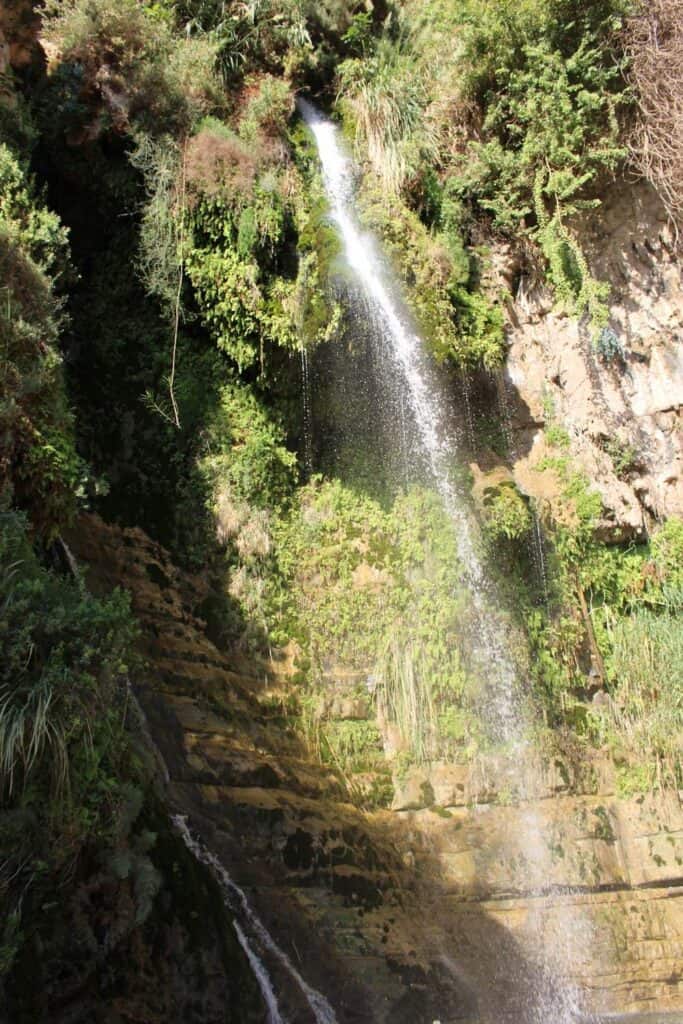
The Desert Oasis Near the Dead Sea
Waterfalls and green canyons in the middle of the harshest desert in the country, a few miles from the Dead Sea. Ibex on the rocks, caves in the cliffs, and one of the great moral scenes of the Old Testament.
Nothing quite prepares pilgrims for Ein Gedi. You drive along the Dead Sea through bare rock and salt flats, with nothing growing anywhere, and then suddenly there is an oasis pouring out of a canyon with a stream running down it, trees, reeds, and water falling off the cliffs.
Why there is water here
Rain falling on the Judean hills soaks into the limestone and travels underground eastward. Where the rock layers meet the fault line above the Dead Sea, the water comes back out as powerful springs. Four of them feed this oasis.
The result is a strip of green a few hundred yards wide in a landscape that gets a couple of inches of rain a year. Ibex come down to drink and clamber on the rocks, unbothered by visitors, and rock hyraxes sun themselves on the ledges. The birdlife is remarkable because there is nowhere else for miles to go.
Ein Gedi means “spring of the kid”, meaning a young goat, and the name has been attached to this place for three thousand years.
David sparing Saul in the cave at Ein Gedi
This is the setting of one of the sharpest scenes in First Samuel.
David, hunted by Saul, was hiding with his men in the wilderness of En-gedi. Saul came after him with three thousand chosen men, and along the way went alone into a cave, the very cave in whose recesses David and his men were hidden. His men urged him to take the chance. David cut off the skirt of Saul’s robe instead, and then felt bad for even that.
When Saul left, David called after him from the cave mouth, held up the piece of cloth, and said: “Know thou and see that there is neither evil nor transgression in mine hand” (1 Samuel 24:11). Saul wept and acknowledged that David was more righteous than he was.
Stand in this canyon and take in the view. The cliffs are honeycombed with caves. The light outside is blinding and the interiors are black, which is precisely why a man stepping in from the sun would see nothing. And the acoustics of a narrow canyon carry a voice a long way, which is how the conversation afterward worked.
What else happened here
Ein Gedi turns up throughout scripture. Chronicles identifies it with Hazazon-tamar (2 Chronicles 20:2). The Song of Solomon compares the beloved to a cluster of henna in the vineyards of En-gedi (Song of Solomon 1:14). Ezekiel’s vision of a healed Dead Sea imagines fishermen standing from En-gedi to En-eglaim (Ezekiel 47:10).
Archaeology adds layers. Above the spring are the remains of a temple from around four thousand years before Christ, one of the oldest ritual structures in the country. Later there was a settlement here through the Iron Age and a village in the Roman and Byzantine periods.
That village made a fortune from balsam, a fragrant resin grown in this oasis and prized across the Roman world. The village synagogue has a mosaic floor with a long Aramaic inscription that pronounces a curse on anyone who reveals the secret of the town. Most scholars connect that to the balsam trade: a village guarding a process worth a great deal of money.
Walking the canyons at Ein Gedi
Two canyons are open to visitors. The shorter walk up Nahal David reaches a waterfall in about twenty minutes on a good path and suits nearly everyone. The longer route up Nahal Arugot is quieter, wilder, and takes a couple of hours.
Bring water, wear a hat, and if possible, go early. The heat here is serious, and the canyon retains that heat throughout the day.
Pilgrims sometimes ask whether Lehi and his family could have passed through country like this on the journey described at the opening of the Book of Mormon. The route lies in the right general direction, and terrain of this kind is what the wilderness south and east of Jerusalem looks like. Treat it as a way of picturing the landscape rather than as a claim about a specific site, since nothing identifies one.
What I want groups to take from Ein Gedi is the mercy in the cave. David had the man who was hunting him at his mercy, in the dark, with his own men telling him to kill Saul. Yet David had mercy on Saul and let him go. And still his conscience troubled him over a piece of cloth. That is a high standard, set in a place where you can see exactly how easy the other choice would have been.
Come and See
Why did David hide here, and why does the Song of Songs remember this place?
Walk up to the falls with us.
| Explore Upcoming Departures | Prepare To Be A Pilgrim |
 |

Sources and Further Reading
- Rachel Hachlili, Ancient Synagogues – Archaeology and Art: New Discoveries and Current Research (Brill, 2013).
- Jodi Magness, The Archaeology of the Holy Land: From the Destruction of Solomon’s Temple to the Muslim Conquest (Cambridge University Press, 2012).
- Jerome Murphy-O’Connor, The Holy Land: An Oxford Archaeological Guide from Earliest Times to 1700, 5th ed. (Oxford University Press, 2008).
