

And Is It From the Time of Jesus?
A drought in 1986 dropped the lake far enough to expose a fishing boat buried in the mud. It dates to the right century. What it is and what it is not are both worth knowing before you see it.
This is one of the most important objects in the country, and it is also one of the most oversold. Both of those things can be true, and pilgrims get more out of the visit when they know the difference going in.
How the Galilee Boat was found in 1986
In early 1986 the Sea of Galilee was unusually low after years of drought and heavy water use. Two brothers from a kibbutz on the northwest shore, both amateur archaeology enthusiasts, were walking the newly exposed mud when one of them spotted the outline of ancient nails and wood.
What followed was an eleven-day emergency excavation under real pressure. The lake could rise at any time. The waterlogged timbers had held together for two thousand years only because they had stayed wet and buried; exposed to air, they would have crumbled. The team worked around the clock, and in the end they encased the entire hull in polyurethane foam, which let the boat float, and towed it along the shore to a conservation pool.
Conservation then took years. The waterlogged wood had to be saturated with a chemical that replaced the water and supported the cell structure, a slow process that cannot be rushed. The boat is now displayed at the Ginosar museum on the shores of the Sea of Galilee.
What the Galilee Boat is
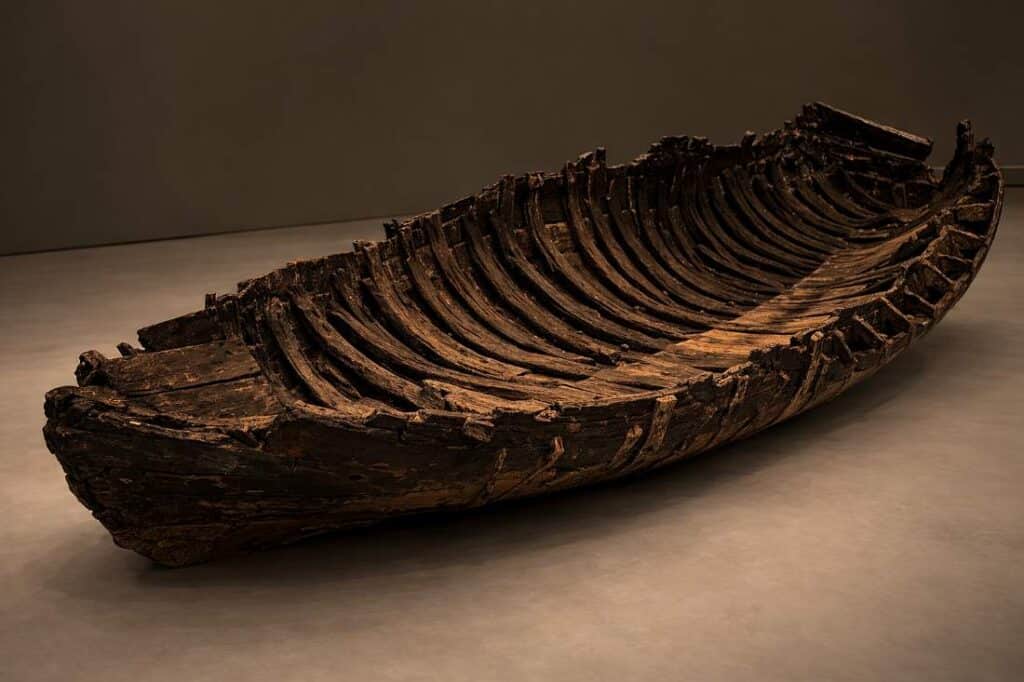
The hull is about twenty-seven feet long and seven and a half feet wide, built with the mortise-and-tenon joinery used across the ancient Mediterranean. A boat this size would carry a crew of about five, and could hold fifteen people.
Three independent lines of evidence date it: radiocarbon analysis of the wood, the style of construction, and pottery and a lamp found alongside it. Together they place it roughly between the first century before Christ and the first century after, which is precisely the period the Gospels describe.
One detail moves people more than the dating does. The boat was built and repaired from at least a dozen different kinds of wood, including pieces clearly salvaged from other vessels. Good timber was scarce and expensive around this lake. Whoever owned this boat kept it working with whatever could be found, patching it over years. It is a working man’s boat, mended and mended again.
Why it should not be called the Jesus Boat
It is often called the Jesus Boat, and that name has done it a disservice.
Nothing connects this hull to Jesus or to any of the disciples. No inscription, no location tie, no distinguishing feature. What can be said is that it is a fishing boat of the right kind, from the right lake, in the right period. When Peter and Andrew and James and John worked these waters, they worked from a boat very much like this one, and possibly from this one, and there is no way to know.
The careful claim is stronger than the loose one. A boat that certainly belonged to Peter would be a relic. A boat that certainly represents the vessels those men used every working day tells you something about their lives, which is what the Gospels are actually asking you to understand.
What to look for at the museum
Stand at the bow and take in the size. It is small. Then remember the account of the storm, with waves breaking over the sides and the boat filling while Jesus slept in the stern (Mark 4:37–38). Look at where the stern is. Look at how little freeboard there is between the top plank and the water.
Then remember that these men made their living going out at night onto a lake known for sudden violent winds, in this. Their courage was ordinary and daily, and it was considerable.
For most pilgrims, seeing this boat and then going out on the Sea of Galilee on a modern day boat helps the scriptures come unmistakably alive.
Come and See
How might seeing a boat from the time of Jesus change the way you read the storm on the lake?
See it and decide.
| Explore Upcoming Departures | Prepare To Be A Pilgrim |
 |

Sources and Further Reading
- Jodi Magness, The Archaeology of the Holy Land: From the Destruction of Solomon’s Temple to the Muslim Conquest (Cambridge University Press, 2012).
- Jerome Murphy-O’Connor, The Holy Land: An Oxford Archaeological Guide from Earliest Times to 1700, 5th ed. (Oxford University Press, 2008).
- Shelley Wachsmann, The Sea of Galilee Boat: An Extraordinary 2000 Year Old Discovery (Plenum Press, 1995).
