

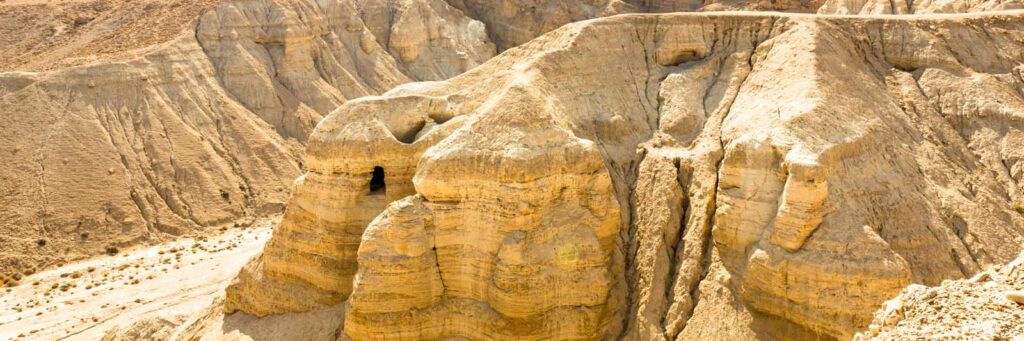
A modest ruin above the Dead Sea, eleven caves, and the manuscripts that closed a thousand-year gap in the history of the biblical text.
Qumran itself is unimpressive at first glance: low stone walls, water channels, a tower, some cisterns, on a marl terrace above the Dead Sea with cliffs behind and heat everywhere. Groups sometimes wonder why they stopped. Then they look up at the cave openings in the cliff face and the reason becomes clear.
What was found in the Qumran caves
The first scrolls came to light in the late 1940s, found by Bedouin shepherds in a cave near the site. Searching continued for a decade, and manuscripts were eventually recovered from eleven caves in the cliffs and terraces around Qumran. One cave alone yielded thousands of fragments.
The collection runs to hundreds of manuscripts. Roughly a quarter are copies of books of the Hebrew Bible, and every book except one is represented. The rest are commentaries, hymns, prayers, calendars, legal texts, and documents describing the life and rules of a community.
Why they matter so much
Here is the point that pilgrims most often miss, and it is the whole reason these manuscripts changed our understanding of the world of Jesus and the Bible.
Before this discovery, the oldest complete Hebrew manuscripts of the Old Testament in existence dated from around the tenth century after Christ. That left a gap of more than a thousand years between the writing and our oldest copies, and scholars had no way to test how faithfully the text had been transmitted across it.
The scrolls closed that gap. Manuscripts from roughly the second century before Christ could now be compared, word by word, with the copies that had come down through the Middle Ages. The great scroll of Isaiah, nearly complete and about twenty-four feet long, made that comparison possible for an entire book.
The result deserves care in both directions. The words preserved in the Bible have proved remarkably stable across those centuries, which was a genuine surprise to many scholars. There are also real differences: spelling, occasional word order, and in some books more substantial variation, along with evidence that more than one version of certain books circulated. What the scrolls demonstrate is a transmission process that was both careful and human.
Who lived at Qumran
The site was excavated in the 1950s by a French priest and archaeologist working from the Ecole Biblique in Jerusalem. He concluded that Qumran was home to a Jewish religious community that had withdrawn to the desert, and he identified them with the Essenes, a group described by Josephus, Philo, and Pliny the Elder. On his reading, the long room was a dining hall, another room was a scriptorium where scrolls were copied, and the many stepped pools were ritual baths.
That interpretation has been challenged. Some scholars have argued the site was a fortified manor house, or a pottery works, or a commercial estate, and that the scrolls were brought out from Jerusalem for safekeeping when Rome approached rather than written here. Glassware and fine stone vessels found in the ruins were offered as evidence of wealth rather than austerity.
Most archaeologists working on the site today hold to a version of the original view, arguing that the alternatives fit the physical evidence less well. The stepped pools are numerous and elaborate for a farm, but would make sense for a group of people, like the Essenes, who cared deeply about ritual purity. The connection between the settlement and the caves, where the scrolls were discovered, remains the majority position.
Seeing the scrolls themselves
The site and the manuscripts are in two different places. At Qumran you see the cliffs, the caves, and the settlement. At the Shrine of the Book museum in Jerusalem you see the manuscripts, displayed in a building designed around the great Isaiah scroll.
Visit them in that order if you can. The cave first, then the writing that came out of it, is a better sequence than the reverse.
What the site at Qumran is like
What gets me at Qumran is the ordinariness of the survival. No one preserved these documents. A community stored them in jars in caves in one of the driest places on earth, and then the community ended, and the jars sat in the dark for two thousand years while empires came and went, and a shepherd threw a stone into a cave opening looking for a lost sheep. He heard pottery break. And instead of a lost sheep, we heard the words of the Bible from the time of Jesus.
Come and See
Why did a community move into the desert to copy scripture?
Look at the caves with us.
| Explore Upcoming Departures | Prepare To Be A Pilgrim |
 |

Sources and Further Reading
- Jodi Magness, The Archaeology of Qumran and the Dead Sea Scrolls (Eerdmans, 2002).
- Roland de Vaux, Archaeology and the Dead Sea Scrolls (Oxford University Press, 1973).
- James C. VanderKam, The Dead Sea Scrolls Today (Eerdmans, 2010).
- Geza Vermes, The Complete Dead Sea Scrolls in English (Penguin, 2004).
