

The Feeding of the Multitude and Feed My Sheep
Warm springs run into the lake here, which drew the fish, which drew the fishermen. Two small churches on that shoreline hold a feeding and a reinstatement.
Tabgha is quiet, green, and easy to walk. The name is a worn-down version of a Greek word meaning seven springs, and the springs are the reason for everything here.
Why the fish gathered
Several warm mineral springs rise along this stretch of shore and flow into the lake. Warm water and the nutrients it carries attract fish, particularly in the cooler months, and fishermen on this lake knew it.
So this short piece of coastline was among the best fishing grounds on the Sea of Galilee, a couple of miles from Capernaum. When the Gospels place fishermen and crowds along this shore, they are describing the part of the lake where the work actually was.
The Church of the Multiplication
The first church sits a short walk from the water and commemorates the feeding of the multitude.
The present building is modern, raised in the twentieth century over the remains of Byzantine churches. What survives from those earlier buildings is the floor, and it is remarkable.
In front of the altar is a fifth-century mosaic showing a basket of loaves flanked by two fish. It is one of the most reproduced images in Christian art and it is on the floor in front of you. Around the nave, the wider mosaic pavement shows the marsh birds and plants of the lakeshore in extraordinary detail: herons, ducks, cormorants, flowering reeds. The artists were depicting what they could see out the door.
Beneath the altar is a plain slab of rock, venerated as the place of the miracle. A pilgrim traveling in the late fourth century described a stone at this site, which tells us the tradition was in place very early.
The Gospels do not fix the feeding to a precise spot. What this place gives you is the right shoreline, an early tradition, and a floor laid by people who lived here and loved the look of their own lake.
The Church of the Primacy of Peter
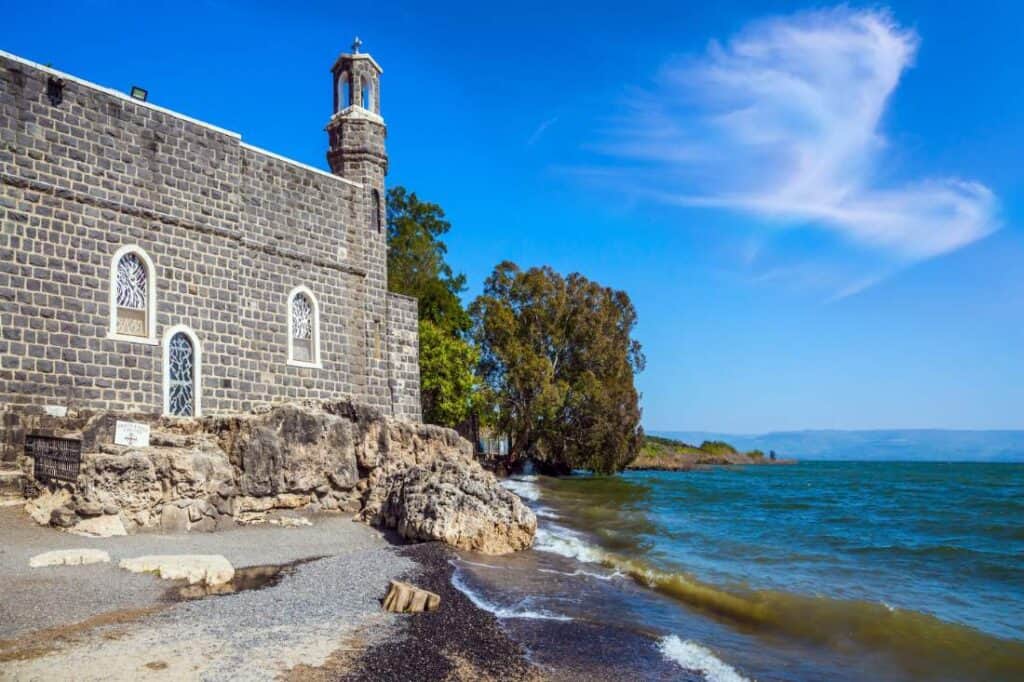
A short walk away, right at the water, is a small chapel built of black basalt. It is dark inside, simple, and it holds the moment many pilgrims find hardest to get through without emotion.
Inside, a flat shelf of rock projects from the floor toward the water. It has been called the table of Christ for centuries, marking the breakfast in John 21.
Go outside and down the rock-cut steps to the shore, because the account is worth reading standing there. The disciples had gone back to fishing and caught nothing all night. A man on the beach told them where to cast. They came in dragging a full net and found a charcoal fire with fish already on it and bread, and Jesus fed them.
Then, three times, Jesus asked Peter whether Peter loved Him, and three times told him to feed His sheep (John 21:15–17). Peter had denied Him three times beside another charcoal fire in a courtyard in Jerusalem. This is where that was answered.
How to experience this location
Tabgha is where we can slow a Galilee day down.
Here we sit (or stand) at the water’s edge, with the lake in front of us and the hills across it, and read John 21 aloud, and then stop talking for a while.
Most groups have someone in them who needs that chapter. A person who failed at something they care about, who assumes the failure is the end of the story, hears a risen Christ cook breakfast for the man who denied Him and then hand him the assignment to continue in the work anyway. This is the same call to all of us today.
Come and See
Why do so many Gospel events cluster along this short stretch of shoreline?
Sit by the water with us.
| Explore Upcoming Departures | Prepare To Be A Pilgrim |
 |

Sources and Further Reading
- Jodi Magness, The Archaeology of the Holy Land: From the Destruction of Solomon’s Temple to the Muslim Conquest (Cambridge University Press, 2012).
- Jerome Murphy-O’Connor, The Holy Land: An Oxford Archaeological Guide from Earliest Times to 1700, 5th ed. (Oxford University Press, 2008).
