

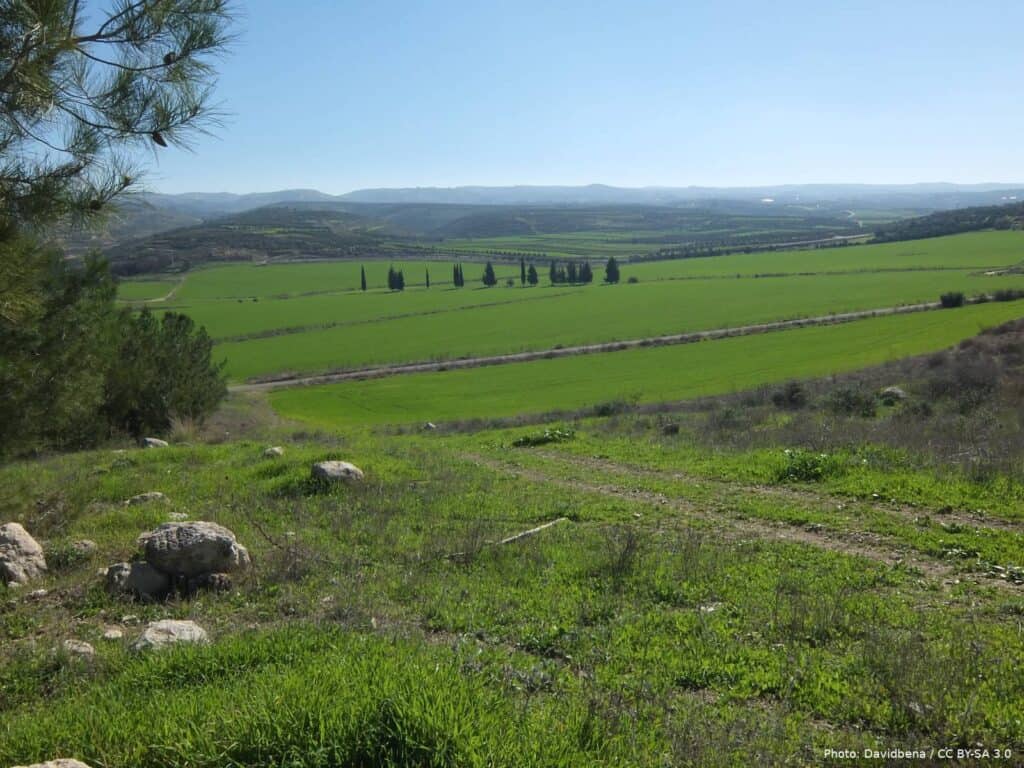
The Valley of Elah is a real place with two named hills, a brook full of smooth stones, and a fortified city on the ridge above that has reopened one of the sharpest arguments in biblical archaeology.
This is one of the few Old Testament sites where the biblical description and the landscape line up so plainly that you can stand in the valley and place the armies by reading the chapter aloud.
What the text describes
First Samuel gives coordinates. The Philistines gathered at Socoh and camped between Socoh and Azekah. Saul and the men of Israel camped in the valley of Elah, and the two armies drew up “on a mountain on the one side, and Israel stood on a mountain on the other side: and there was a valley between them” (1 Samuel 17:3).
Socoh and Azekah are known locations, and the valley between them is a known location. The two ridges are there, the ground between them is broad and open, and the distance across it is close enough for a shouted challenge and far enough that forty days of standoff makes sense.
Then comes the detail pilgrims come for: “And he took his staff in his hand, and chose him five smooth stones out of the brook” (1 Samuel 17:40). The brook runs through the valley floor, and its bed is full of rounded stones. Nearly every pilgrim picks one up. I encourage it.
The sling as a military weapon
One correction is worth making, because it changes how the story reads.
A sling in this period was a serious military weapon rather than a boy’s toy. Armies fielded units of slingers, and Judges records seven hundred left-handed Benjamite slingers who could hit a target with precision (Judges 20:16). A trained slinger could put a stone into a man at a considerable distance with real force behind it.
So the encounter looks different from the usual picture of a helpless boy against a giant. It is a heavily armored close-combat fighter facing a skilled ranged fighter who declines to fight on his opponent’s terms. Goliath’s equipment is described in the text at length, and every piece of it is designed for an enemy who comes near. David never came near.
That takes nothing away from the account. David says clearly what he is relying on: “I come to thee in the name of the Lord of hosts, the God of the armies of Israel” (1 Samuel 17:45). Understanding the tactics makes the confidence more interesting.
The city on the ridge
On a hilltop overlooking the valley sits Khirbet Qeiyafa, and it has become one of the most argued-over excavations in the country.
Between 2007 and 2013 excavators uncovered a small fortified city of about five and a half acres, ringed by a casemate wall built from enormous stones still standing several feet high. Houses were built directly against the wall, a plan known from later cities of Judah. Radiocarbon dates place the city in the late eleventh or early tenth century BC, which is the era the Bible assigns to David. And an inscribed pottery fragment was found near the western gate, one of the earliest inscriptions of its kind from this region.
The city has two gates, which is unusual, and the excavators connect that with the biblical place name Shaaraim, meaning two gates, which appears in the chapter about the Philistines fleeing after Goliath falls (1 Samuel 17:52).
Here is why it matters and why it is contested. If this is a Judahite fortress built in David’s time, it points to a kingdom organized enough to plan and garrison a border city facing Philistia, which argues against the view that David ruled little more than a hill village. Other archaeologists read the same evidence differently, proposing that the city belonged to the Canaanites, or to the Philistines, or to a northern kingdom, and they question whether the finds carry the weight the excavators place on them.
The argument is ongoing and it is conducted by serious people on both sides. What no one disputes is that somebody built a substantial fortified city on this ridge at almost exactly the period the Bible describes, watching the road up from Philistine territory toward the hill country.
What the Valley of Elah is like today
The valley is quiet farmland now. You can see both ridges at once, and the brook is a short walk from the road. Pilgrims pick up stones and turn them over and go silent, and it is easy to see why. Nearly everyone comes to this valley carrying something they are facing that is larger than they are.
The story has been used to promise that the underdog wins, which is a shallower reading than the chapter supports. What David actually brought to the valley was a skill he had built over years alone with sheep, a refusal to fight on terms designed for someone else, and a stated confidence in God rather than in his own equipment. That is worth carrying home along with the stone.
Come and See
How might picking up a stone from that brook change a story you have known since childhood?
Stand in the Elah Valley with us.
| Explore Upcoming Departures | Prepare To Be A Pilgrim |
 |

Sources and Further Reading
- Yosef Garfinkel and Saar Ganor, Khirbet Qeiyafa Vol. 1: Excavation Report 2007–2008 (Israel Exploration Society, 2009).
- Amihai Mazar, Archaeology of the Land of the Bible: 10,000–586 B.C.E. (Doubleday, 1990).
- Jerome Murphy-O’Connor, The Holy Land: An Oxford Archaeological Guide from Earliest Times to 1700, 5th ed. (Oxford University Press, 2008).
