

More armies have fought at this one hill than almost anywhere on earth, and the reason is a narrow pass through a ridge. The name Armageddon comes from here, and what that means is worth getting right.
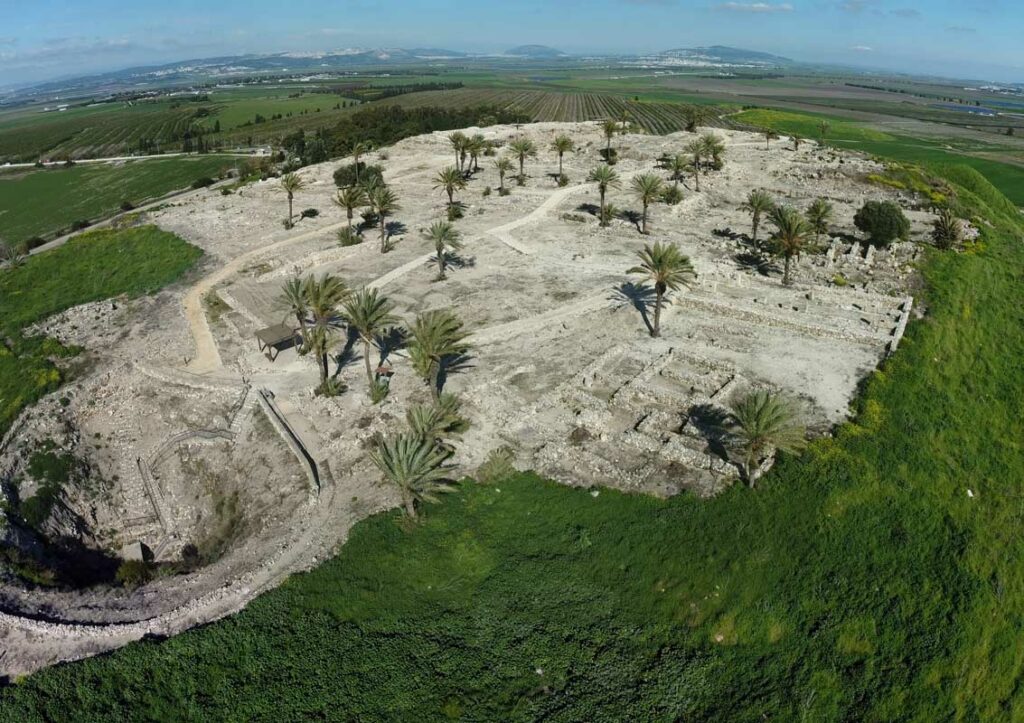
Megiddo looks modest from the parking lot: a flat-topped mound rising above farmland at the western edge of the Jezreel Valley. Climb it and the reason for everything becomes visible in about ten seconds.
The pass through the Carmel ridge
The Carmel ridge runs down toward the coast and blocks the main route between Egypt and Mesopotamia. A few narrow valley passes cut through it, and the most useful of them opens right below this hill. Any army marching between the great powers of the ancient world, and any caravan carrying trade between them, came through that gap.
Whoever held Megiddo controlled the pass. They controlled trade. They controlled military advantage. That is the whole story of the site, and it explains why more than twenty cities were built here, one on the ruins of the last, over roughly six thousand years. The mound you climb is those cities stacked up.
The battles fought at Megiddo
The earliest battle in recorded history described in real detail was fought here. Around 1457 BC the Egyptian pharaoh Thutmose III marched north against a coalition of Canaanite kings, chose the riskiest of the three approaches through the ridge because his enemies would expect the safer ones, and came out of the pass below Megiddo. His scribes recorded the campaign in detail, and the account was carved on temple walls at Karnak. He is said to have told his officers that capturing Megiddo was like capturing a thousand cities.
Israelite history runs through the same ground. Deborah and Barak fought a battle here (Judges 5:19). Ahaziah died here (2 Kings 9:27). And King Josiah, one of Judah’s best kings, was killed here when he went out against Pharaoh Necho (2 Kings 23:29), a loss that shook the kingdom.
The list keeps going long past the Bible. Crusaders in the high middle ages; Napoleon in 1799; British forces under Allenby in 1918 during World War I. All fought in this valley. Warfare technology changed completely across those centuries. But the geography did not.
What you see on the mound at Megiddo
Three things reward attention on the summit.
A monumental city gate with six chambers, three on each side, of a design also found at Hazor and Gezer. First Kings names those three cities together as places Solomon fortified (1 Kings 9:15), and for decades the gate was presented as Solomon’s. That dating is now contested. Some archaeologists hold to the tenth century and Solomon; others place the gate and the large public buildings a century later, under the northern kings. The debate is a live one and worth knowing about before a guide tells you it is settled.
Long pillared buildings, often called Solomon’s stables. They may have housed horses, and they may have been storehouses, and the same chronology argument applies to their date.
And the water system, which is the highlight. A shaft was sunk more than a hundred feet down through the mound, and a tunnel driven from its base out to a spring at the foot of the hill. The spring’s outer opening was then sealed and hidden, so the city could draw water during a siege without anyone leaving the walls. You walk down the shaft and out through the tunnel, and the engineering logic is identical to what Hezekiah later did at Jerusalem.
No water, no city and no civilization.
Where the name Armageddon comes from
The word appears once in scripture: “And he gathered them together into a place called in the Hebrew tongue Armageddon” (Revelation 16:16).
Armageddon is a Greek rendering of a Hebrew phrase meaning the mount, or hill, of Megiddo. So the name points here, to this mound and the valley below it.
What that means is a separate question, and readers land in different places. Some take it as a literal geographic prophecy about a future battle on this plain. Others read it as John reaching for the most battle-soaked name in his people’s memory, using a real place as an image of final conflict the way we might say a decision has its Waterloo or D-Day. The text itself gives the name and moves on.
What you can say with confidence, standing on the mound, is why the name was available to be used. This is the valley where armies have come to decide things for four thousand years, and John’s readers knew it.
How to take in the site
We talk about the gate. We talk about layers of civilization. At the overlook at the north end of the mound you see the valley sweep far to the left and right. From there you can see the pass, the plain, Nazareth on the ridge across the way, and Mount Tabor beyond.
We walk the water system. And we let the expansive reality settle in that the water that made this place possible supported six thousand years of human occupation.
Megiddo is fascinating for its past, present, and future.
Come and See
Why did so many armies fight for this one hill?
Look out over the valley with us.
| Explore Upcoming Departures | Prepare To Be A Pilgrim |
 |

Sources and Further Reading
- Eric H. Cline, The Battles of Armageddon: Megiddo and the Jezreel Valley from the Bronze Age to the Nuclear Age (University of Michigan Press, 2000).
- Amihai Mazar, Archaeology of the Land of the Bible: 10,000–586 B.C.E. (Doubleday, 1990).
- Jerome Murphy-O’Connor, The Holy Land: An Oxford Archaeological Guide from Earliest Times to 1700, 5th ed. (Oxford University Press, 2008).
