

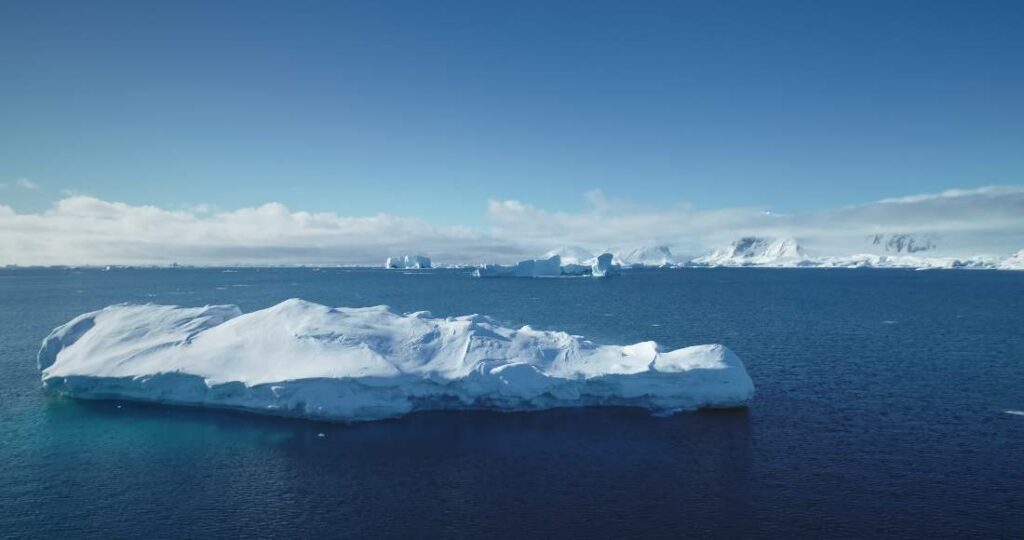
Day 10 · December 29, 2027 · The Antarctic Peninsula
Antarctica looks white in pictures. The first surprise of December 29 is the color.
Documentaries show it white. White ice, white sky, white water, and a flat horizon running both directions.
Then you come up on deck on the morning of December 29, and the color is wrong.
The night the ocean goes quiet
The ship changes before anyone announces it. Somewhere in the small hours, the long swell of the Drake Passage shortens and settles. The roll stops. Some people wake up because of the stillness.
By breakfast, small pieces of ice are drifting past the hull. The crew calls them brash ice and growlers. They knock against the plating like someone moving furniture in the cabin below yours.
Then the big ones come.
Why the ice is blue
Snow falls on Antarctica and never melts. More snow falls on top of it. Year after year, the weight above squeezes the air out of the snow below.
What is left is ice with almost no bubbles in it.
That is the whole explanation. Bubbles are what make an ice cube look white. Bubbles scatter light straight back out at you. Glacial ice sends light deep inside instead. The ice absorbs the red along the way. Blue is what comes back to your eye.
Reading that explanation takes a paragraph. Seeing the color takes about two seconds.
Bring a real camera if you own one. Phone cameras are calibrated for scenes where the brightest thing is white, so this blue comes out gray.
Why icebergs are hard to measure
Tabular icebergs break off the floating edge of an ice shelf. The top of one is as flat as a runway. The sides drop straight down like a wall.
Your eye measures distance by comparing things to sizes you already know. Nothing on a berg has a size you already know. So your brain guesses, and your brain guesses badly.
A berg that looks a few hundred yards off the rail can be three miles away. It can also be taller than a ten-story building.
Here is a trick that helps. Measure the berg against the ship. Then remember that the ship is 1,083 feet long.
And what you can see is about one-eighth of the berg. The other seven-eighths sits under the water.
What Antarctica sounds like
When conditions allow it, the captain slows the ship to a drift among the ice. Then you can hear the ice.
Melting bergs give off a fine crackle across the water. That sound is air escaping. The air got trapped in the snow on the day it fell. Sailors named the sound bergy seltzer, because it comes out like carbonation in a glass.
Every so often you get something louder. A crack, then a long rumble. A glacier has dropped part of its face into the sea.
Sound travels a long way over cold, flat water. You hear the calving first. By the time you find the cliff, the wave is already spreading out from it.
Whales, penguins, and seals from the rail
Late December is feeding season. The krill are thick in these waters, and the animals that eat krill come up to work.
Humpback whales feed here through the summer. The blow comes first, a puff of vapor over the water. Then the back. Then the tail going down.
Gentoo and chinstrap penguins travel in fast little groups. They porpoise in and out of the water the way dolphins do.
Leopard seals rest on flat pieces of floating ice. Cape petrels follow the wake.
All of this happens from the ship. The rails, the upper decks, your own balcony. Bring binoculars, because everything here is farther away than it looks.
The first people to see this coast
People first laid eyes on this coast in 1820. They sailed wooden ships. They wore wool. They carried no chart of the water underneath them. They had no way to tell whether the land behind the ice ran a hundred miles or a thousand.
Ernest Shackleton took his ship into the Weddell Sea in 1914, east of the water you will be sailing. The pack ice closed around her. It held her for ten months. In November 1915 the pressure crushed her, and she sank.
Shackleton got all twenty-seven of his men out alive. It took him a year and a half.
Part of that was an open-boat voyage. He and five men sailed a twenty-two-foot lifeboat to South Georgia, about eight hundred miles away. Cloud covered them for most of the crossing. The navigator managed four sightings of the sun in sixteen days. They found the island.
You will cross that same ocean with a stabilized hull, a warm cabin, and breakfast waiting.

