

And What Happened There?
He built a world-class port on a coastline with no natural harbor, using concrete that hardens underwater. Then Rome ran Judea from it, Paul spent two years in its jail, and a stone with Pilate’s name on it turned up in the theater.
Most pilgrims arrive at Caesarea for the ruins by the sea and leave having realized it is one of the most important sites in the New Testament. The Gospels never mention it. Acts is full of it.
Why Herod built a harbor where there was no bay
Look at a map of Israel’s Mediterranean coast and notice what is missing. There is no deep bay, no sheltering headland, no island breakwater. It is a long, straight, sandy shore, which is beautiful and useless for shipping. For centuries that coastline kept the region turned inland.
Herod decided to build a harbor anyway. Beginning around 22 BC, his engineers constructed two enormous curving breakwaters out into open water, enclosing a basin large enough for a substantial fleet. The technique came from Rome: hydraulic concrete, mixed with volcanic ash shipped in from Italy, which sets hard underwater. Forms were floated into position, filled, and sunk.
He named the harbor Sebastos, the Greek form of Augustus, and the city Caesarea, and then he built the city to match: a theater, a hippodrome, an aqueduct running from springs at Mount Carmel, a palace on a promontory reaching into the sea, and a temple to Rome and to the emperor set where sailors would see it first.
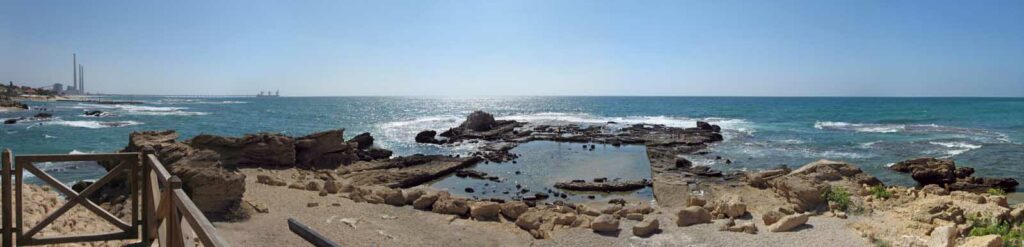
The harbor eventually settled and silted, and much of it now lies underwater, which is why a good deal of what we know about it comes from divers rather than diggers.
The stone with Pilate’s name
In 1961 an Italian team working in the theater turned over a block of limestone that had been reused as a building stone. On its face was a damaged Latin inscription, and the surviving letters name Pontius Pilate and give his office as prefect of Judea.
This is the only inscription naming Pilate ever found. Its value runs in two directions. It confirms that a Roman official by that name governed Judea, and it settles his title. Later writers sometimes called him procurator; the stone from his own province, cut in his own lifetime, calls him prefect, which is a military office. That fits a governor whose main job was keeping order.
The original is in the Israel Museum in Jerusalem, and a replica stands at the site.
What happened here in Acts
Caesarea was the Roman administrative capital of Judea. Governors lived here and traveled up to Jerusalem for the festivals. That single fact puts a remarkable amount of the New Testament on this ground.
Philip preached here and later hosted Paul in his home (Acts 8:40; 21:8). Peter came here to the house of Cornelius, a Roman centurion, and while he was still speaking the Holy Ghost fell on the Gentiles present, which broke open the question of who the gospel was for (Acts 10). Herod Agrippa I was struck down here after accepting the crowd’s acclaim as a god (Acts 12:21–23), an event the historian Josephus also records.
And Paul was held here for two years. He was brought under guard from Jerusalem, and he made his defense in this city before the governor Felix, then before Festus, and then before King Agrippa, where he appealed to Caesar (Acts 23–26). From this harbor he sailed for Rome.
Paul’s jail cell was only recently discovered in 1997 and made available for public visits starting June 9, 2025.
Why Caesarea matters for reading Acts
Groups often treat Caesarea as the pleasant Roman ruin at the end of a long day. I put it early when I can, because it explains the world the New Testament happens inside.
Sit in the theater with the sea behind the stage and you understand the reach of the empire that governed this province: the concrete from Italy, the Latin inscriptions, the emperor’s temple, the fleet in the artificial harbor. Then remember that a Jewish tentmaker sat in a cell in this city for two years, argued his case in front of three Roman officials, and left through that harbor to make the same argument in Rome. The gospel moved out into the wider world through a port built by Herod to impress Caesar.
Come and See
Why did Herod build a great harbor on a coast with no natural bay?
See what he built.
| Explore Upcoming Departures | Prepare To Be A Pilgrim |
 |

Sources and Further Reading
- Kenneth G. Holum, Robert L. Hohlfelder, Robert J. Bull, and Avner Raban, King Herod’s Dream: Caesarea on the Sea (W. W. Norton, 1988).
- Josephus, The Jewish War, book 1, and Antiquities of the Jews, book 15, on the building of the harbor and city.
- Jodi Magness, The Archaeology of the Holy Land: From the Destruction of Solomon’s Temple to the Muslim Conquest (Cambridge University Press, 2012).
- Jerome Murphy-O’Connor, The Holy Land: An Oxford Archaeological Guide from Earliest Times to 1700, 5th ed. (Oxford University Press, 2008).
