

And Why Does It Matter?
A desert palace, a Roman siege you can still see from the top, and a famous last night that rests on a single ancient source. Sorting those three apart makes the visit better.
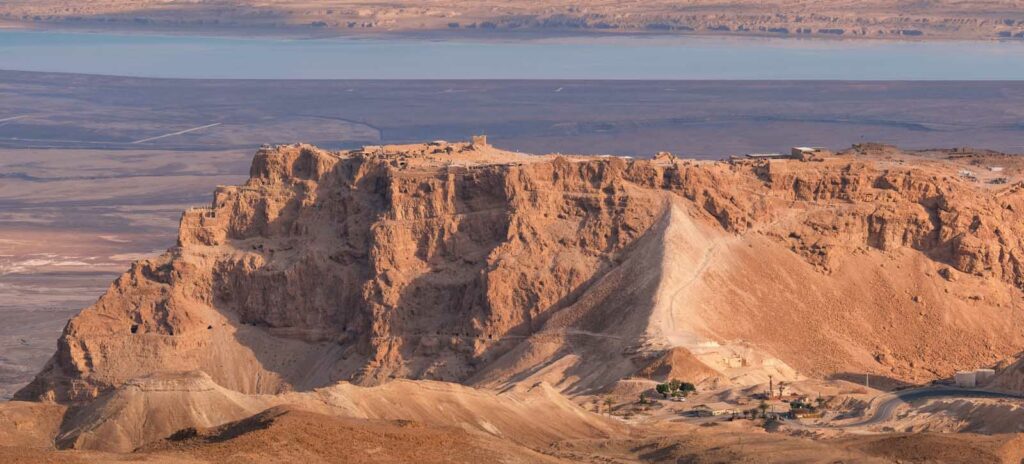
Masada rises about thirteen hundred feet above the western shore of the Dead Sea, a flat-topped mountain with sheer sides on every approach. From the summit you look east over the water to the hills of Jordan and west into empty desert. It is a most dramatic site in Israel, and it carries a story that deserves our attention.
Herod’s palace and fortress on Masada
Herod the Great fortified the mountain in the years before the birth of Christ, and he built it as a refuge. He had reason. He held his throne by Roman favor, he was hated by many of his own subjects, and he expected that someday he might need somewhere no army could reach.
What he made is astonishing engineering. A wall ran around the entire summit. Storerooms held enough food for years. Enormous cisterns cut into the rock captured the rare desert floods and held millions of gallons, which is how a fortress functions in a place with almost no rainfall. There was a bathhouse with a heated floor, and mosaics, and painted plaster.
The showpiece is the northern palace, built on three levels hanging off the cliff face at the northern tip, connected by staircases cut into the rock. Standing above it and looking down at those terraces tells you more about Herod than any written description: enormous wealth, enormous fear, and a builder who solved impossible problems for the pleasure of solving them.
The Roman siege of Masada in AD 73
About seventy years after the death of Herod, during the Jewish revolt against Rome, a group of rebels took Masada and held it. After Jerusalem fell in AD 70, these rebel Jews were among the last holding out. And around AD 73 the Roman governor brought the Tenth Legion into the desert to finish the war.
What the Romans did is still visible from the summit, and it is a very impressive thing to behold. They built a wall clear around the base of the mountain to seal off escape. They laid out eight camps, and the outlines of the camp walls and even the individual tent platforms can still be traced on the desert floor. Then they built a ramp of earth and stone up the western slope, high enough to roll a siege tower and a battering ram against the wall.
Look down at that ramp and the scale of the effort registers. An empire moved a mountain of earth through a waterless desert to take one hilltop from a few hundred people.
The last night, and how we know about it
Everything we know about the final night comes from a single source: the Jewish military general, priest, and historian Josephus, writing for a Roman audience a few years afterward. He reports that when the defenders saw the wall breached and the end certain, their leader persuaded them to die free rather than be taken. He describes lots being drawn, the men killing their families and then one another, and nine hundred and sixty dead by morning, with two women and five children surviving in a cistern to tell the story.
Excavations led by Yigael Yadin in the 1960s uncovered the palace, the storerooms, a synagogue, and more than seven hundred inscribed pottery fragments, including a small group of shards bearing names that Yadin connected with the drawing of lots.
Later scholars have raised substantial questions. Very few human remains were recovered on the summit. Josephus was writing to explain the war to Rome, and speeches in ancient histories were routinely composed by the historian rather than transcribed. Some archaeologists read the evidence as consistent with his account, and others read it as considerably thinner than the account requires.
What stands regardless of that debate: Herod built the fortress, rebels held it, Rome besieged it with extraordinary effort, and it fell. The ramp, the camps, and the siege wall are as solid as evidence gets.
Visiting Masada: cable car, Snake Path, and heat
Go early. By mid-morning the heat on that rock is punishing, and there is very little shade on the summit. Take the cable car up unless you have a specific reason to walk; the Snake Path is a genuine climb, takes about an hour, and should be done at sunrise or skipped (I did have a mountain running friend who ran to the top in under twenty-three minutes!). Bring more water than you think you need. Give yourself at least two hours on top, because the summit is larger than it looks from below.
The three layers of the Masada story
There is Herod, and what his palace reveals about a man who built a refuge he never used. There is Rome, and the siege works still lying in the sand below. And there is the last night, which comes to us through one writer, Josephus, who expresses the anguish of extinguished hope among these Jewish rebels wanting their freedom.
Come and See
Why did a king build a refuge he never used, and why did a few hundred people choose to retreat here?
Ride up early with us.
| Explore Upcoming Departures | Prepare To Be A Pilgrim |
 |

Sources and Further Reading
- Josephus, The Jewish War, book 7, the only ancient account of the siege and its end.
- Jodi Magness, Masada: From Jewish Revolt to Modern Myth (Princeton University Press, 2019).
- Jerome Murphy-O’Connor, The Holy Land: An Oxford Archaeological Guide from Earliest Times to 1700, 5th ed. (Oxford University Press, 2008).
- Yigael Yadin, Masada: Herod’s Fortress and the Zealots’ Last Stand (Random House, 1966).
