

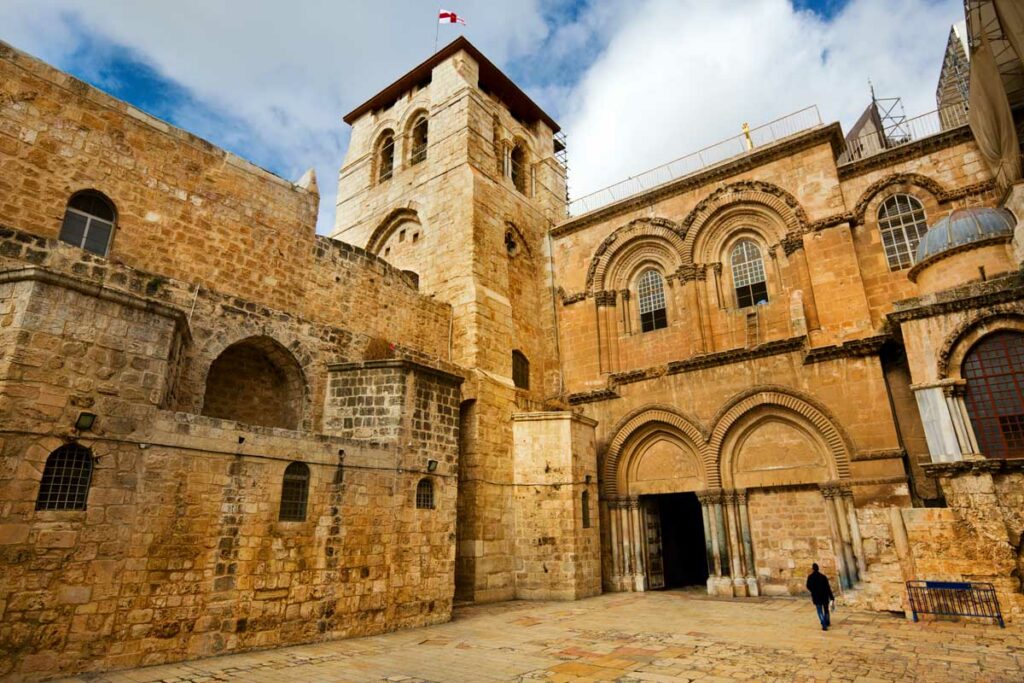
Two places in Jerusalem are shown to visitors as the tomb of Jesus. Here is the evidence for each, and why thoughtful people land in different places.
Almost every pilgrim asks this question. The two places sit less than half a mile apart. One is a huge, dim church full of incense and candles, shared by several Christian churches, where you wait forty minutes to spend ninety seconds inside a marble shrine. The other is a landscaped garden with birdsong and benches, a rolling stone track, and a doorway you can stand in alone. They cannot both be the tomb of Jesus. So which one is it?
The question deserves a real answer rather than a polite one. And a real answer means keeping three things separate: what the Gospel writers describe, what the digging in Jerusalem has turned up, and what a place does for the person standing in it. Those are three different ways of knowing something. All three are worth having.
What the Gospels actually tell us
The descriptions are short and surprisingly specific. The place of the crucifixion is called Golgotha, and it sits near the city: “And he bearing his cross went forth into a place called the place of a skull, which is called in the Hebrew Golgotha” (John 19:17). John goes on: “Now in the place where he was crucified there was a garden; and in the garden a new sepulchre, wherein was never man yet laid” (John 19:41). Matthew adds that the tomb belonged to Joseph of Arimathea, that it was cut out of rock, and that a great stone was rolled across its door (Matthew 27:59–60).
Four details do the heavy lifting. The site stands outside the city wall, since Roman executions happened outside and Jewish law kept burials beyond the walls of a living city. The site stands close enough to the city that people walking by could read the sign above the head of Jesus. There is a garden. And the tomb is freshly cut, with no one buried in it yet.
Those four details are the measuring stick. Everything that follows is an argument about which place matches them.
The case for the Church of the Holy Sepulchre
The strongest argument surprises most visitors, because the church now sits deep inside the current walled Old City, which seems to rule it out immediately. Here is the answer: the city grew. In the AD 30s the wall ran along a different line, and the ground under the church lay outside it, in an abandoned limestone quarry on the northwest edge of town. Digging under and around the church has found that quarry, and has found tombs cut into its rock from the first century. When workers strip the good stone out of a quarry, they leave the bad stone standing in odd knobs and shelves, and later generations cut tombs into the walls. That one fact answers three of the four details at once.
The second argument is memory. Around AD 135, after a Jewish revolt, the emperor Hadrian rebuilt Jerusalem as a Roman city and put a pagan temple platform over this exact spot. Two centuries later, when the emperor Constantine sent workers to find the tomb, they tore that platform down and reported a rock-cut tomb underneath. One emperor covering a site and another uncovering it in the same place is a meaningful chain. It suggests the local Christians remembered this location and kept pointing to it across those two hundred years.
The third argument is the neighborhood. Other first-century tombs still survive inside the church itself. Step into the Syriac chapel at the back, past the crowds, and you can see burial shafts cut into the same quarry face, in the style used in the first century. Whatever else is true, this was a burial ground on the edge of the city in exactly the right period.
The case for the Garden Tomb
The Garden Tomb entered the conversation in the 1880s. European visitors, many of them Protestants uneasy with the crowded and heavily decorated Holy Sepulchre, began looking for a place that matched the Gospel descriptions more plainly. A rocky cliff face north of the Damascus Gate looks, from the right angle, like a skull, and in the 1880s a British general named Charles Gordon championed it. A tomb had been found nearby in 1867. The garden around it was purchased and preserved.
Its supporters make a reasonable case. The cliff stands outside the walls in every reconstruction of the city. It sits beside a main road, which fits the detail about passersby. The grounds hold a very large ancient water cistern and a winepress, and those two things together mean serious farming, which is to say a garden. And the tomb is a real rock-cut tomb with a channel for a rolling stone, in a setting that looks like the scene the Gospels describe.
The pressure on the case comes from the tomb itself. Careful study of how it was cut, and of the tombs around it, points to a date centuries before the first century. One well-known analysis places it in the eighth to seventh centuries BC (the time of Lehi!), with reuse in later centuries; another proposal places it a few hundred years later than that but still well before the time of Jesus. Either way, the tomb was already old when Joseph of Arimathea would have owned it, and that sits awkwardly next to John’s description of a tomb where no one had yet been laid. The skull shape of the cliff carries its own problem: rock erodes, and the face a British officer saw in 1883 is not necessarily the face a Judean saw in AD 33.
Where that leaves the evidence
Weighing the two, most archaeologists and historians who work in Jerusalem favor the Church of the Holy Sepulchre. The quarry, the first-century tombs, the old wall line, and the line of memory running from Hadrian to Constantine all point the same direction, and several separate lines of evidence pointing the same direction is the strongest thing archaeology has to offer. The Garden Tomb’s case rests more on how well the setting matches the scene we picture, and less on the physical evidence of that particular tomb.
Hold that conclusion loosely. Constantine’s workers were three hundred years downstream from the events, working for an emperor who very much wanted a tomb to be found. Local memory across two centuries is a real thing and a fragile one. And the Garden Tomb sits in a landscape that certainly held first-century burials, on the correct side of the wall, beside the correct kind of road. The main summary is that one site has considerably more evidence behind it, and that certainty is more than the evidence can deliver.
This is also where I would keep the archaeology from carrying more than it can prove. Every argument above is about a location. The claim at the center of our faith is about an event, and the Resurrection is the same event no matter which shelf of limestone it happened on.
What each site teaches a visitor
I take groups to both, and I would keep doing so even if the evidence were settled tomorrow, because they teach different things.
The Holy Sepulchre teaches you that this story belongs to somebody besides you. You get jostled. The lamps and icons are unfamiliar. Several ancient churches share the building under an arrangement so delicate that a wooden ladder has sat on a window ledge since the 1700s because no one is permitted to move it. Around you, believers are weeping in languages you do not speak. You are a guest in an old family’s house. An hour there does something useful to the quiet assumption that Christianity begins where our own tradition begins.
The Garden Tomb teaches you the shape of the story. You see the track for the rolling stone, the low doorway you have to stoop through, the burial bench, the garden all around it. Groups sing there. Groups take the sacrament there. Groups sit still there, which is rare on any tour. For many pilgrims it becomes the most affecting hour of the trip.
What I hope pilgrims carry home is the ability to hold both kinds of knowing at once. The archaeology is worth learning thoughtfully, including the places where it points somewhere different than expected. The worship is worth entering fully, including at a site whose stones may come from the wrong century. A person who can do both is reading the Holy Land the way it deserves to be read, full of majesty, meaning, and transformative learning.
Come and See
Why have pilgrims found something at both of these places, when only one of them can be the tomb?
Stand in both with us.
| Explore Upcoming Departures | Prepare To Be A Pilgrim |
 |

Sources and Further Reading
- Dan Bahat, “Does the Holy Sepulchre Church Mark the Burial of Jesus?” Biblical Archaeology Review 12, no. 3 (May/June 1986).
- Gabriel Barkay, “The Garden Tomb: Was Jesus Buried Here?” Biblical Archaeology Review 12, no. 2 (March/April 1986).
- Shimon Gibson, The Final Days of Jesus: The Archaeological Evidence (HarperOne, 2009).
- Jodi Magness, The Archaeology of the Holy Land: From the Destruction of Solomon’s Temple to the Muslim Conquest (Cambridge University Press, 2012).
- Jerome Murphy-O’Connor, The Holy Land: An Oxford Archaeological Guide from Earliest Times to 1700, 5th ed. (Oxford University Press, 2008).
