

And Should I Walk It?
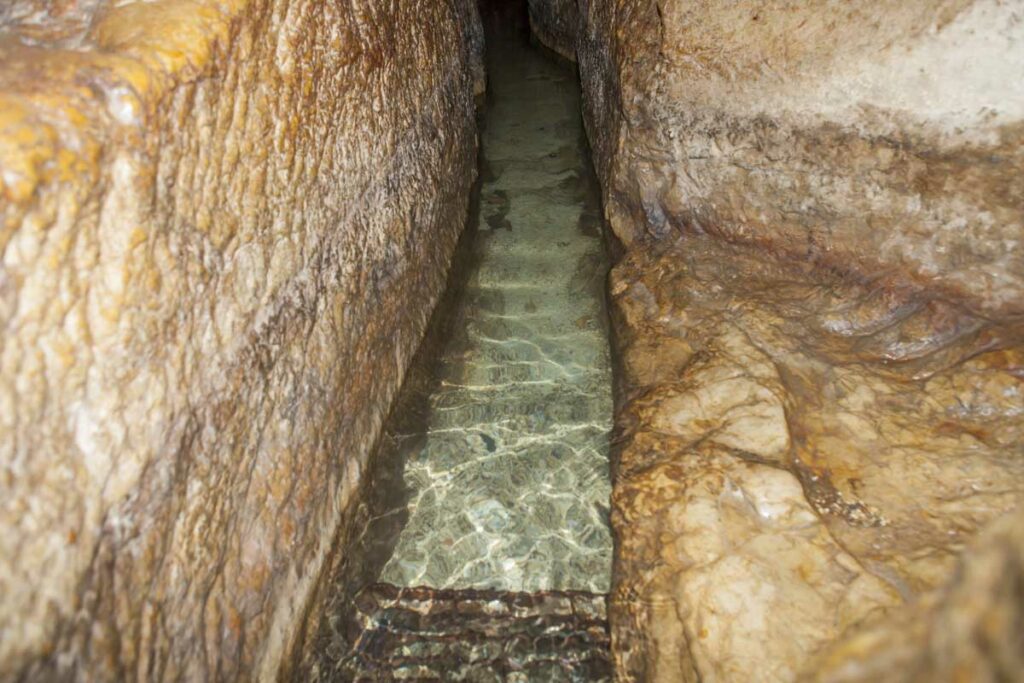
A quarter-mile water channel cut through solid rock in a hurry, around 701 BC, still carrying water. You can walk the whole length in the dark, in the water, and most people should.
Of everything on an Israel itinerary, this is the stop pilgrims talk about longest afterward. It asks more of you than any other half hour of the trip, and it gives back more.
Why Hezekiah cut the tunnel
Jerusalem had one dependable water source, the Gihon Spring, and it sat outside the city wall at the bottom of the eastern slope. That arrangement works until an army arrives. Around 701 BC, with the Assyrian king Sennacherib moving through Judah and taking city after city, Hezekiah faced a siege with his water supply exposed.
Scripture records the response twice. Second Chronicles describes stopping the waters of the springs so the invaders would find nothing to drink, and says that Hezekiah “stopped the upper watercourse of Gihon, and brought it straight down to the west side of the city of David” (2 Chronicles 32:30). Second Kings adds the summary line: “and how he made a pool, and a conduit, and brought water into the city” (2 Kings 20:20).
The plan was to hide the spring, cut a channel through the ridge, and deliver the water to a reservoir inside the walls. The work had to be finished before the army arrived.
How the two crews met in the middle
Two crews began at opposite ends and cut toward each other through solid limestone, using hand tools, working by lamplight. The tunnel runs about 1,750 feet, and it curves in a long S rather than running straight, which has kept scholars arguing for a century about how the crews navigated. Proposals include following a natural crack in the rock, listening for the sound of the other crew’s picks through thin stone, and signaling from the surface above.
What we have from the workers themselves is remarkable. An inscription cut into the tunnel wall near the meeting point describes the moment of breakthrough, when the two teams could hear each other’s voices through the remaining rock and then swung their picks toward one another until the water flowed through. A boy found it in 1880. It now sits in a museum in Istanbul, a legacy of Ottoman rule, and a plaster copy is displayed in Jerusalem.
The fall of the tunnel across its whole length is about a foot. That is the part that impresses engineers. Two crews, no instruments, working blind through a curve, and the water still runs.
What walking it is actually like
You enter at the spring end and walk downstream. The water is cool and clear and generally runs between ankle and knee deep, though it varies with the season. The passage is narrow, often about two feet wide, and the ceiling height changes constantly. Some stretches are twelve or fifteen feet high where the crews cut too deep. Other stretches require you to stoop.
It is completely dark. Groups carry flashlights, and there is a moment partway through when someone always suggests turning them all off. In that darkness, with the water moving around your ankles and the rock inches from both shoulders, you get the closest thing available to what those workers experienced. The walk takes thirty to forty minutes, and it ends at the Pool of Siloam, where a man born blind was sent to wash and came back seeing (John 9:7).
What to wear and bring for Hezekiah’s Tunnel
Wear water shoes or sandals you can soak, with a back strap so they stay on. Bring a small flashlight or a headlamp; a phone works, and a phone you drop in the water stops working. Wear shorts or trousers you can roll, and quick-drying fabric. Leave your bag with the group if you can, or carry it high.
Two situations call for the alternative route. If narrow dark spaces make you anxious, or if you would rather stay dry, take the Canaanite channel that runs alongside it. It is dry, wider, and shorter, and it rejoins everyone at the same exit. Nobody in your group needs to know which route you took, and taking the dry one is a perfectly good choice.
Why the tunnel walk is worth the time
Most of what you see in the Holy Land requires a guide to explain the connection between the ground in front of you and the text in your hand. This is one of the few places where the two are the same object. Scripture describes a tunnel being cut. You are standing in the tunnel. The water it was cut to carry is still moving past your feet toward the pool it was built to fill.
I have walked it many times, and it lands the same way every time. Come out at the far end soaked to the knees, blinking in the sunlight, and you understand something about Hezekiah, and about the people who did the work, that no lecture delivers.
Come and See
Why did a king cut a tunnel through solid rock, and what was he afraid of?
Bring shoes you can soak.
| Explore Upcoming Departures | Prepare To Be A Pilgrim |
 |

Sources and Further Reading
- Amihai Mazar, Archaeology of the Land of the Bible: 10,000–586 B.C.E. (Doubleday, 1990).
- Ronny Reich, Excavating the City of David: Where Jerusalem’s History Began (Israel Exploration Society, 2011).
