

And How Could Anyone Hear It?
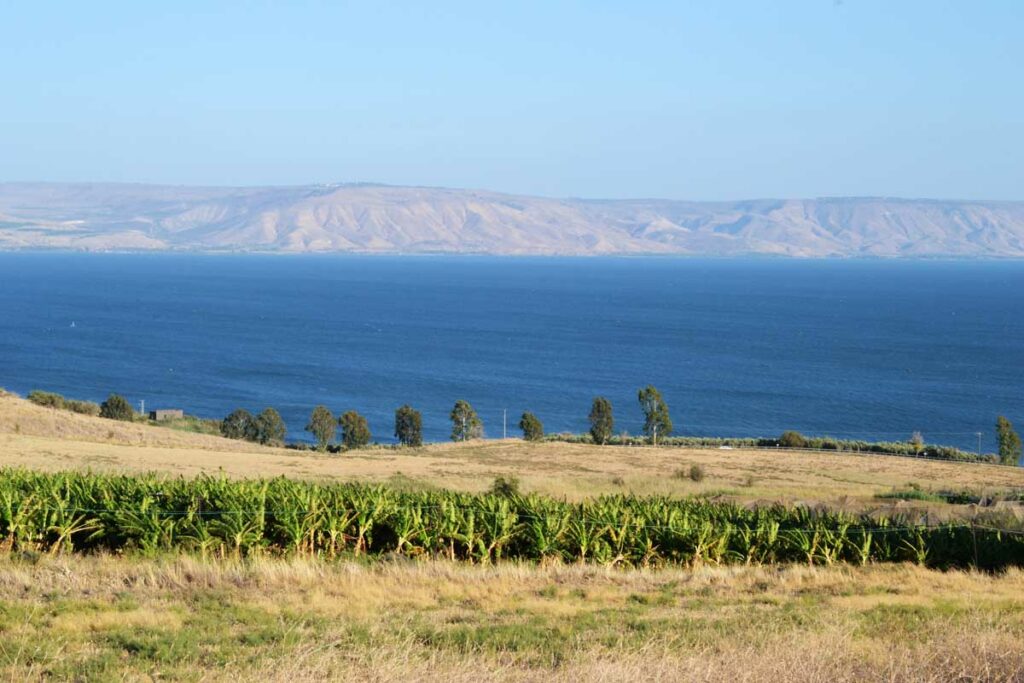
One Gospel puts the sermon on a mountain and another puts it on a level place. The hillside above the Sea of Galilee resolves that, and an acoustic study done in 1976 answers the harder question.
Two questions come up at this stop every single time. Where exactly did it happen? And how could thousands of people hear one man speaking outdoors, with no amplification, on a windy hillside?
The second question has a better answer than most pilgrims expect.
What the Gospels say about the place
Matthew sets the scene on high ground: “And seeing the multitudes, he went up into a mountain: and when he was set, his disciples came unto him” (Matthew 5:1). Luke gives a version of the same teaching and places it lower: Jesus “came down with them, and stood in the plain, and the company of his disciples, and a great multitude of people” (Luke 6:17).
Readers sometimes treat that as a contradiction. Stand on the ground in question and it stops being one. The slopes above the northwest shore of the Sea of Galilee rise in a series of terraces and level shelves, and a speaker can climb the hill, then stand on a flat place partway up with the crowd spread on the slope below and around. Both descriptions fit the same afternoon. Luke’s word describes a level area, which a hillside terrace certainly is.
The traditional site
The Church of the Beatitudes, built in 1938, sits on the hillside above Tabgha with a view down the length of the lake. It commemorates rather than claims: no ancient tradition fixes the sermon to that precise spot. Pilgrims in the Byzantine period were shown a place lower on the same slope, and remains of a small early chapel have been found there.
What the site does offer is the correct terrain. You are on the hillside above the shore, within a couple of miles of Capernaum, looking out over the water. Whatever the exact patch of grass, the geography is right, and the geography is what teaches.
The acoustics test
In the 1970s an archaeologist named B. Cobbey Crisler noticed how well sound traveled on these slopes and decided to measure it. He persuaded a Massachusetts acoustics firm to send an engineer, and together they ran electronic tests at a cove on the shore near the ruins of Capernaum, a natural bowl in the hillside now often called the Cove of the Sower.
The results were published in 1976. The cove works as a natural amphitheater. A single unamplified voice, speaking from a boat just offshore or from a rock at the water’s edge, carries clearly up the slope. Crisler calculated that five to seven thousand people could be seated in the area below the modern road, and that the full hillside could hold more than twice that number.
The test also turned up something the researchers had not expected. Sound traveled in both directions. A person speaking from partway up the slope could be heard clearly down at the shore. The bowl works as a room.
Read the Gospels with that in mind and several details sharpen. Matthew describes Jesus getting into a boat and teaching the crowd standing on the shore (Matthew 13:2), which sounds like a way to gain a little distance and turns out to be a way to gain a stage. His repeated instruction to those who have ears to hear lands differently in a place where hearing was the whole design. And the crowds of thousands that the Gospels describe stop being a narrative exaggeration and become a seating estimate.
What the hillside above the lake is like today
The lesson I want pilgrims to carry away has less to do with acoustics than with method. Jesus taught outdoors, in a place chosen so that a crowd could actually hear, using the shape of the land itself as His equipment. The setting was part of the teaching. That is a very practical thing to notice about the Master Teacher, he taught so that all who were willing could hear. That is still true today.
Come and See
How might hearing the Beatitudes on a Galilee hillside change the way you read them?
Read them with us on the hillside.
| Explore Upcoming Departures | Prepare To Be A Pilgrim |
 |

Sources and Further Reading
- B. Cobbey Crisler, “The Acoustics and Crowd Capacity of Natural Theaters in Palestine,” The Biblical Archaeologist 39, no. 4 (December 1976): 128–141.
- Jodi Magness, The Archaeology of the Holy Land: From the Destruction of Solomon’s Temple to the Muslim Conquest (Cambridge University Press, 2012).
- Jerome Murphy-O’Connor, The Holy Land: An Oxford Archaeological Guide from Earliest Times to 1700, 5th ed. (Oxford University Press, 2008).
