

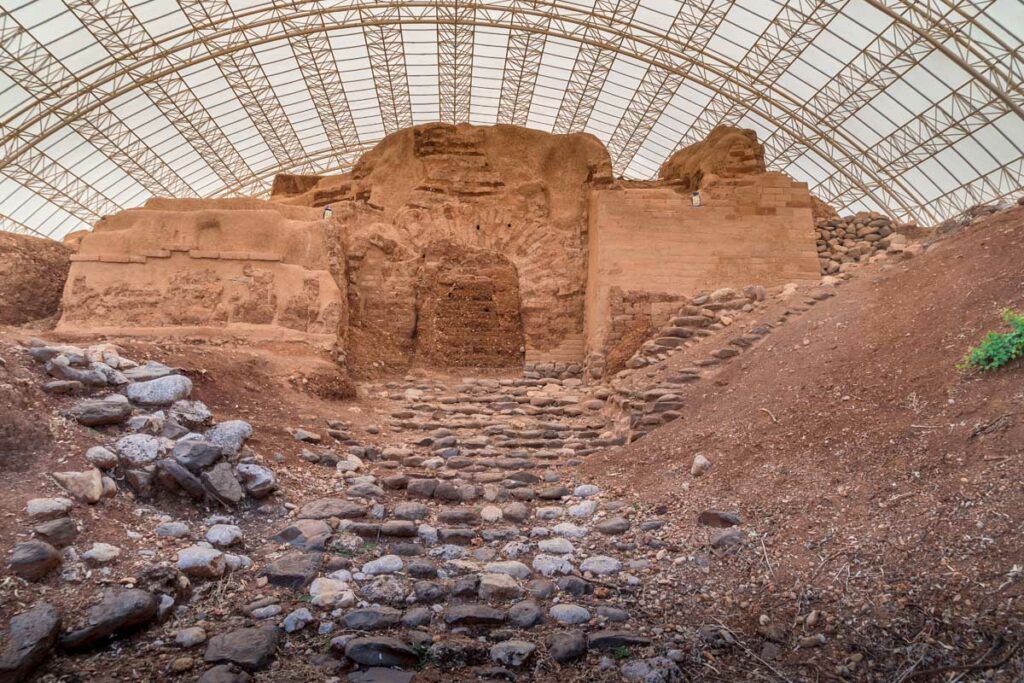
A gate from the time of Abraham that you can see! The location of Israel’s golden calf, and a broken stone that carries the first mention of David found outside the Bible.
Tel Dan surprises people twice. The first surprise is the water: this is one of the main sources of the Jordan River, and the site is a nature reserve of rushing streams and heavy shade, which is the last thing most pilgrims expect in Israel. The second surprise is how much history is packed into a short walk.
Dan as Israel’s northern border
Scripture uses a phrase for the whole land: from Dan to Beersheba. Dan is the northern end of that expression, and standing here you can see why. Mount Hermon rises above you, the border of Lebanon is close, and beyond lies what was Aramean territory. This was the frontier, and frontiers get fortified.
The town began as a Canaanite city called Laish. Judges tells how the tribe of Dan, squeezed out of its allotted land near the coast, sent scouts north, found a quiet and unprotected town, took it, and renamed it after their ancestor (Judges 18).
The gate Abraham’s world would recognize
The most striking thing at Tel Dan is a mudbrick gateway from around 1750 BC, built with a true arch. It survives because the builders later buried it inside an earthen rampart, which sealed and protected the brickwork instead of letting it dissolve in the rain.
Two things make it remarkable. Mudbrick almost never survives four thousand years, and a genuine arch this old is rare enough that the structure is often described as among the oldest standing arched gateways known anywhere in the world. You are looking at brickwork so ancient that even Abraham could have passed through it in Genesis 14!
Jeroboam’s high place and the golden calf
After Solomon’s kingdom split, the northern king Jeroboam faced a political problem: his people would keep traveling south to the temple in Jerusalem, and their loyalty would follow their worship. His solution is recorded plainly. He made two calves of gold and told the people it was too much to go up to Jerusalem, and “he set the one in Beth-el, and the other put he in Dan” (1 Kings 12:29).
The high place he built is here, and it is large. You can see the platform, and a metal frame has been set up to outline the size of the altar that stood on it. Beside it are the remains of an installation for handling sacrifices.
It is a sobering stop. The text treats this as the sin that shaped the northern kingdom’s whole history, and here is the platform, and it is enormous, and it was clearly used for a long time by a great many people.
This is where the people of Israel apostasized from God. The Ten Tribes started their turn from God here when Jeroboam commanded false worship around 922 BC. Two hundred years later in 722 BC the Assyrians swept these people into captivity and they were lost to history.
The gathering of Israel that we so often talk about is happening because of the dispersion that started here because of apostasy and faithlessness to God.
The stone that named David
In July 1993 a member of the excavation team noticed writing on a stone built into a later wall. Two more pieces were found the following June. Together they are fragments of a victory monument in Old Aramaic, set up by a king of Damascus, most scholars think Hazael, in the ninth century BC.
The text boasts of killing a king of Israel and a king of the house of David.
That phrase is why the fragments matter. Before this discovery, no mention of David had been found outside the Bible, and some scholars had argued David might be a later legend rather than a historical king. A hostile foreign monument, cut roughly a century after his lifetime, refers to the kingdom of Judah as the house of David, which is how ancient inscriptions name a dynasty after its founder.
Debate followed, as it should have. Questions were raised about how the fragments join, how the letters divide into words, and whether the phrase could mean something else. The great majority of scholars now accept the reading, and a minority still argue against it. The stele is on display in the Israel Museum in Jerusalem.
This, then, is the oldest and only inscription about king David outside the Bible.
What a visit to Tel Dan is like
The site takes about ninety minutes to visit and it is a genuine pleasure to walk, shaded and green with water running beside the path the whole way.
What I want pilgrims to notice is the range. In one short loop you pass a Canaanite gate older than the patriarchs, the altar platform of the northern kingdom’s calf worship a thousand years later, the Israelite city gate with a paved plaza where elders sat to judge, and the findspot of the inscription that put David into the extrabiblical record. Very few places let you stand inside more than one thousand years of Biblical history in an hour and a half.
Come and See
Why did the northern kingdom put a rival sanctuary at the far edge of the land of Israel?
See for yourself.
| Explore Upcoming Departures | Prepare To Be A Pilgrim |
 |

Sources and Further Reading
- Avraham Biran, Biblical Dan (Israel Exploration Society, 1994).
- Avraham Biran and Joseph Naveh, “An Aramaic Stele Fragment from Tel Dan,” Israel Exploration Journal 43 (1993): 81–98.
- Avraham Biran and Joseph Naveh, “The Tel Dan Inscription: A New Fragment,” Israel Exploration Journal 45 (1995): 1–18.
- Amihai Mazar, Archaeology of the Land of the Bible: 10,000–586 B.C.E. (Doubleday, 1990).
