

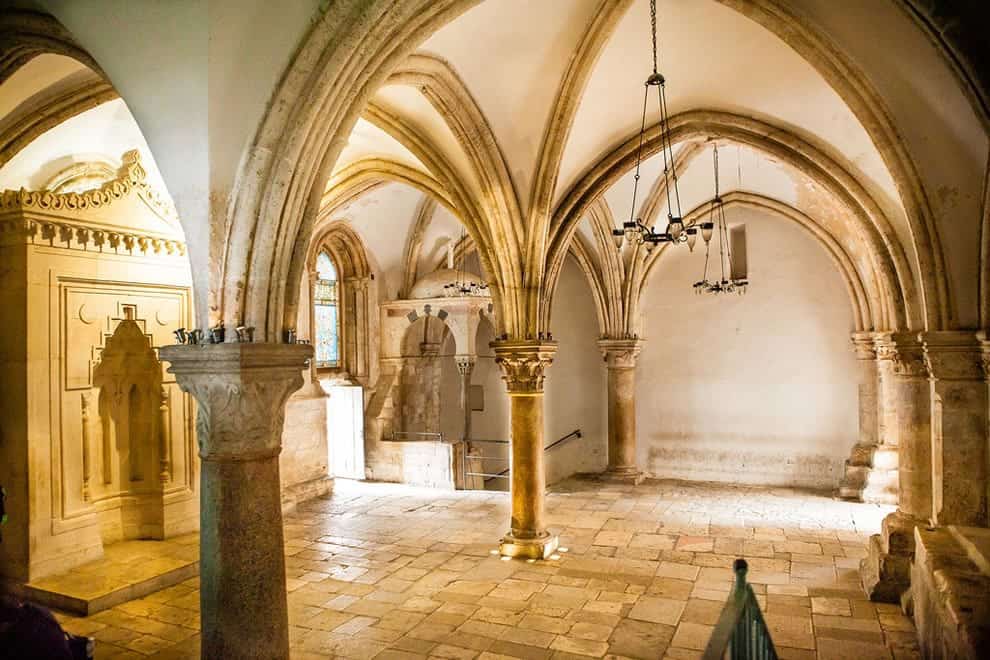
The room shown to visitors on Mount Zion was built by Crusaders, sits above a tomb that almost certainly holds nobody, and may still stand on the right spot. Here is how all three of those can be true at once.
Few sites in Jerusalem ask a visitor to hold as many things in mind at the same time. You climb a stone staircase into a large Gothic hall with pointed arches and slender columns. A prayer niche is set into the south wall, pointing toward Mecca. Below your feet is a chamber where Jewish men and women pray at a draped memorial to King David. And the guidebook says this is where the Savior ate the Last Supper with His disciples.
Every one of those layers is real. Sorting them out takes about ten minutes and makes the visit far better.
What the New Testament describes
Two events are involved, and the accounts are brief. For the Passover meal, Jesus sends two disciples into the city, where a man carrying a pitcher of water will lead them to a house. The instruction is specific: “And he will shew you a large upper room furnished and prepared: there make ready for us” (Mark 14:15). After the Ascension, the apostles return to the city and go up “into an upper room, where abode both Peter, and James, and John” (Acts 1:13), and it is in that setting that the day of Pentecost arrives.
Notice something the tradition assumes. Mark describes a room borrowed for one meal. Acts describes a room the apostles were living in. Christian tradition has treated these as the same room since at least the 300s, and the text itself leaves that open rather than stating it. Both are upper rooms in Jerusalem, and that is as far as the words go.
One more detail is worth having. A large furnished upper room in first-century Jerusalem suggests a household of means, and the wealthy quarter of the city sat on the western hill, which is the hill we now call Mount Zion. So the general neighborhood fits the description well.
The building you actually walk into
The hall itself is medieval. Crusaders rebuilt this structure in the twelfth century as part of a church dedicated to St. Mary of Zion, and the Gothic columns and vaulting you photograph belong to that work. Franciscan friars purchased the property from the ruling sultan in 1332 and set up a friary around it, some of which still stands. In 1524 the Ottoman authorities converted the hall into a mosque, which is where the prayer niche in the south wall comes from. A recent survey of the walls identified more than forty medieval inscriptions and pieces of pilgrim graffiti cut into the stone by visitors who came long before you did.
So the room you stand in was built roughly eleven centuries after the Last Supper. That settles what the room is. It leaves open the question of what stood on the spot before the current building.
The case that the location is right
Christian pilgrims were shown a site on this hill in the 300s, and a great Byzantine basilica called Hagia Zion was built nearby. Two ancient artworks, the mosaic map at Madaba in Jordan and a mosaic in Rome, both show that basilica with a smaller building beside it, which may well be this one. Christian use of this ground runs continuously from the fourth century forward.
There is also a hint from underneath. When the building was damaged during the fighting in 1948, an Israeli archaeologist examined the lower chamber and found a mosaic floor and a niche in the wall some distance below the present floor level, both dated to the Roman period. What that earlier structure was remains genuinely unsettled. Proposals include an early synagogue, a pagan shrine, and a Jewish-Christian meeting house, and serious scholars have argued each one.
The largest gap in our knowledge is simple and surprising: no full archaeological excavation has ever been carried out at this building. It has been too holy to too many people for too long. Much of what we would like to know sits under a floor nobody is permitted to lift.
The tomb downstairs
Now for the chamber below. The Bible is clear about where David was buried: “So David slept with his fathers, and was buried in the city of David” (1 Kings 2:10). The City of David is the narrow southeastern ridge below the Temple Mount, which is where Jerusalem began. It sits about half a mile from this building.
The confusion came from a mistake in geography. By the medieval period the original City of David lay buried and forgotten, and European Christians looked at the tall western hill, decided it must be the ancient city, and named it Mount Zion. Once the hill had that name, a royal tomb was expected to be on it, and in the twelfth century the Crusaders furnished one. The stone box beneath the drape is a memorial rather than a burial.
The devotion that has gathered at that chamber over eight centuries is genuine, and it is worth understanding on its own terms. The historical claim about David is one the evidence declines to support.
How to visit the Upper Room
Three sentences, and then we go in. The room is Crusader work. The site has been shown to Christians since the 300s, which is early enough to take seriously. The tomb below is a memorial rather than a grave, and it matters enormously to the people praying at it.
What makes this stop valuable is exactly the layering that confuses people at first. A Crusader hall, an Ottoman prayer niche, a Jewish memorial, a Byzantine memory, and a Roman-period floor somewhere below all occupy one small building. That is Jerusalem in miniature. Every group that understands the layers leaves with a better sense of the city than the ones who came looking for a single clean answer.
What I love to share here, or nearby, is that at Jesus’s last Passover meal, he would have sung Psalm 113-118 (The Egyptian Hallel) with his disciples. Read those and think about what they mean about Jesus and what Jesus may have been feeling and thinking when he sang those for the last time as a mortal.
Come and See
Why did the first disciples gather in an upper room, and what happened in rooms like it?
Let us look at that together in Jerusalem.
| Explore Upcoming Departures | Prepare To Be A Pilgrim |
 |

Sources and Further Reading
- David Christian Clausen, The Upper Room and Tomb of David: The History, Art and Archaeology of the Cenacle on Mount Zion (McFarland, 2016).
- David Christian Clausen, “Mount Zion’s Upper Room and Tomb of David,” Biblical Archaeology Review (January/February 2017).
- Jerome Murphy-O’Connor, The Holy Land: An Oxford Archaeological Guide from Earliest Times to 1700, 5th ed. (Oxford University Press, 2008).
- Bargil Pixner, “Church of the Apostles Found on Mt. Zion,” Biblical Archaeology Review 16, no. 3 (May/June 1990): 16–35, 60.
