

And Why Was Saul’s Body Taken There?
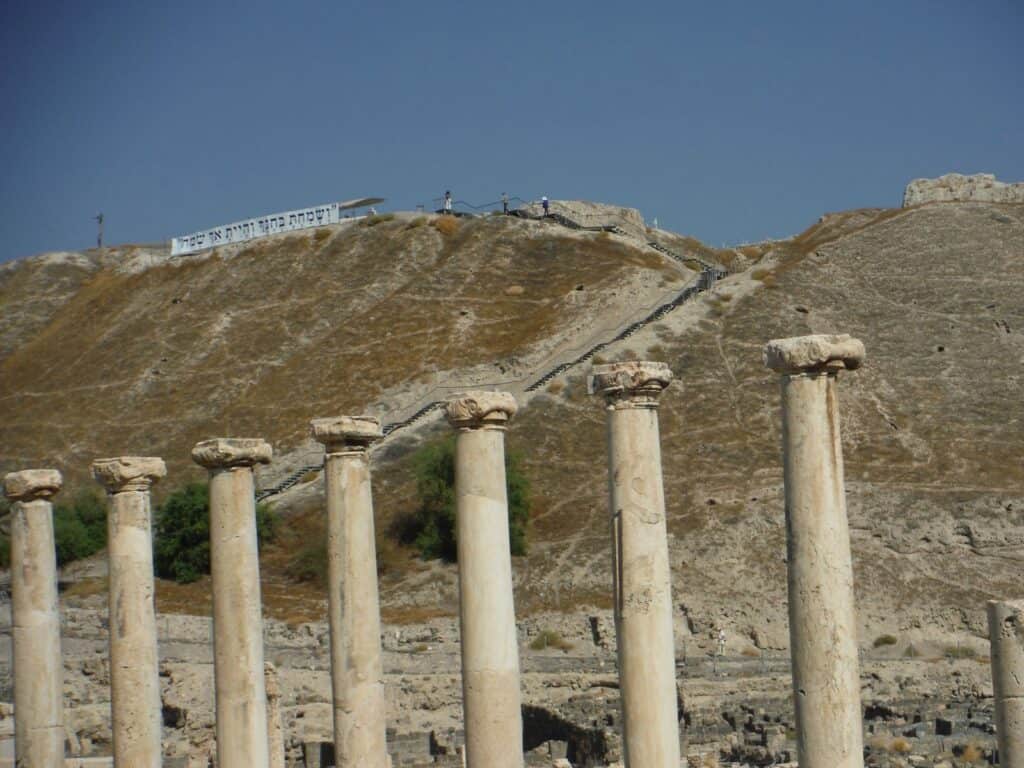
A mound holding twenty layers of cities sits above the largest excavated Roman town in Israel, where columns still lie in rows exactly as an earthquake dropped them in AD 749.
Beth Shean gives you two sites stacked on top of each other, and most pilgrims underestimate both until they arrive. The mound holds thousands of years of the Old Testament world. The city spread below it holds a Roman streetscape from the New Testament time period so complete that you can walk it like a town that was only recently abandoned.
Why anyone built here
Beth Shean sits where the Jezreel Valley meets the Jordan Valley. Two of the most important routes in the region cross at this point, and there is abundant water and rich soil. A rabbinic saying held that if the garden of Eden is in the land of Israel, its gate is at Beth Shean.
Control a crossroads like that and you control trade and troop movement in both directions. So the site was occupied and fortified again and again, and the mound rose as each city was built on the ruins of the last.
The Egyptian centuries
For roughly three hundred years in the Late Bronze Age, Egypt governed this region, and Beth Shean was one of its administrative bases. Excavation on the mound has uncovered an Egyptian governor’s residence and inscribed monuments set up by pharaohs.
That matters for reading Joshua and Judges. The Israelites entering Canaan were entering territory where Egypt still had garrisons and officials, and the strongest fortified places in the valleys were the hardest for them to take. Judges says plainly that the tribe of Manasseh did not drive out the inhabitants of Beth-shean and its towns (Judges 1:27), and standing on this mound at the intersection of two valleys, you can begin to understand why this place matters. The fact that Egyptians had their garrison here gives a strong reason for why it did not fall.
Saul’s body on the wall of Beth Shean
This is the site’s darkest hour, and the geography explains the choice.
Saul and his sons died fighting the Philistines on Mount Gilboa, which rises a few miles to the west and is visible from the mound. The next day the Philistines found the bodies, cut off Saul’s head, and “put his armour in the house of Ashtaroth: and they fastened his body to the wall of Beth-shan” (1 Samuel 31:10).
Choosing this wall was deliberate. Beth Shean stood at the crossroads, where every traveler between the valleys would pass. Displaying the body of Israel’s first king here was an announcement, aimed at the largest possible audience.
Then comes one of the acts of courage in the Old Testament. The men of Jabesh-gilead, whom Saul had rescued at the beginning of his reign, traveled all night, took the bodies down from the wall, and carried them home for burial (1 Samuel 31:11–13). Jabesh-gilead lay across the Jordan. They came a long way, into hostile territory, in the dark, to repay a debt from forty years earlier.
Scythopolis, the Roman city below the mound
Centuries later a Greek and then Roman city grew at the foot of the mound under the name Scythopolis. It became the leading city of the Decapolis, the league of Hellenistic cities in this region during the time of Jesus, and the only Decapolis city on the western side of the Jordan.
What has been excavated is remarkable. Colonnaded streets with the paving stones still in place. A theater seating several thousand. Bathhouses with mosaic floors and the pillars of the underfloor heating still standing. A public fountain, shops, and a central plaza.
Then, in AD 749, a massive earthquake struck the region and the city fell. It was never rebuilt on the same scale. The columns along the main street came down in the same direction and lie where they landed, in rows, which is a most memorable sight on the site. You can stand at the head of that street and see the direction the ground moved nearly thirteen hundred years ago.
Why Beth Shean belongs on an itinerary
Beth Shean does something for pilgrims that few sites manage: it collapses the distance between the Old Testament and the New.
You climb the mound and read about Saul in the era of the Philistines. You come down the same slope and walk a paved Roman street of the kind Paul walked, in a city of the sort that surrounded Galilee in the Gospels. Same hill, one afternoon, two worlds.
It also puts the Decapolis on the map for people. When Mark says crowds came to Jesus from the Decapolis (Mark 5:20; 7:31), this is the kind of place he means: a Greek city with a theater and a temple, close enough to Galilee that its people could walk over to hear a Jewish teacher, and different enough that doing so meant crossing a cultural line.
Come and See
Why did the Philistines choose this city wall to display the body of Saul?
Walk both cities.
| Explore Upcoming Departures | Prepare To Be A Pilgrim |
 |

Sources and Further Reading
- Jodi Magness, The Archaeology of the Holy Land: From the Destruction of Solomon’s Temple to the Muslim Conquest (Cambridge University Press, 2012).
- Amihai Mazar, Archaeology of the Land of the Bible: 10,000–586 B.C.E. (Doubleday, 1990).
- Jerome Murphy-O’Connor, The Holy Land: An Oxford Archaeological Guide from Earliest Times to 1700, 5th ed. (Oxford University Press, 2008).
