

The wooden barn in our nativity sets comes from northern Europe. What the earliest sources describe is a cave, a village house, or both at once, and the difference changes the story in a way worth knowing.
Every December we set out the same scene: a wooden shed with an open front, a star on the roof, animals arranged in the straw, and a family alone in the night because a hard-hearted innkeeper turned them away. It is a beautiful picture, and almost none of it comes from Luke.
Taking the picture apart is worth doing, because what replaces it is warmer rather than colder.
What Luke actually says
One verse carries the whole scene: “And she brought forth her firstborn son, and wrapped him in swaddling clothes, and laid him in a manger; because there was no room for them in the inn” (Luke 2:7).
That is the entire description. A manger, which is a feeding trough. And a place with no room, which the King James Version renders as an inn. What Luke leaves out is remarkable once you notice it. No stable. No barn. No innkeeper. No animals. No cave. Those arrived later, some from tradition and some from art.
The word rendered inn is worth one sentence of attention, because English hides something here. Luke uses a general word meaning a lodging place or guest room. When he wants to describe a commercial inn with a proprietor, as in the parable of the Good Samaritan, he uses a different and more specific word. Many translators now render the phrase in Luke 2 as “no room in the guest room”, which points at a house rather than a business.
What a Judean village house was like
Here is where the archaeology of ordinary life changes the picture. A typical village house in this period was a single family structure with two levels inside one room. The family lived and slept on a raised platform at the back. The lower area near the door was where the household’s animals were brought in at night, for warmth and for safekeeping, and feeding troughs were cut into the stone or built up at the edge of the raised platform, right where the two levels met.
Read Luke against that floor plan and the scene reorganizes itself. A family arrives in their ancestral town, crowded with relatives who have come for the same census. The guest room upstairs is already full. So they are welcomed into the main family room, and when Jesus is born He is laid in the feeding trough at the edge of the living space, because it is the safest place in the house for a newborn.
Notice what that does to the story. The picture of a couple turned away into the cold is replaced by a picture of a crowded house making room. In a culture where hospitality carried enormous obligation, and where Joseph was returning to the town of his own family, a relative refusing shelter to a woman in labor would have been close to unthinkable.
Then why does everyone say cave?
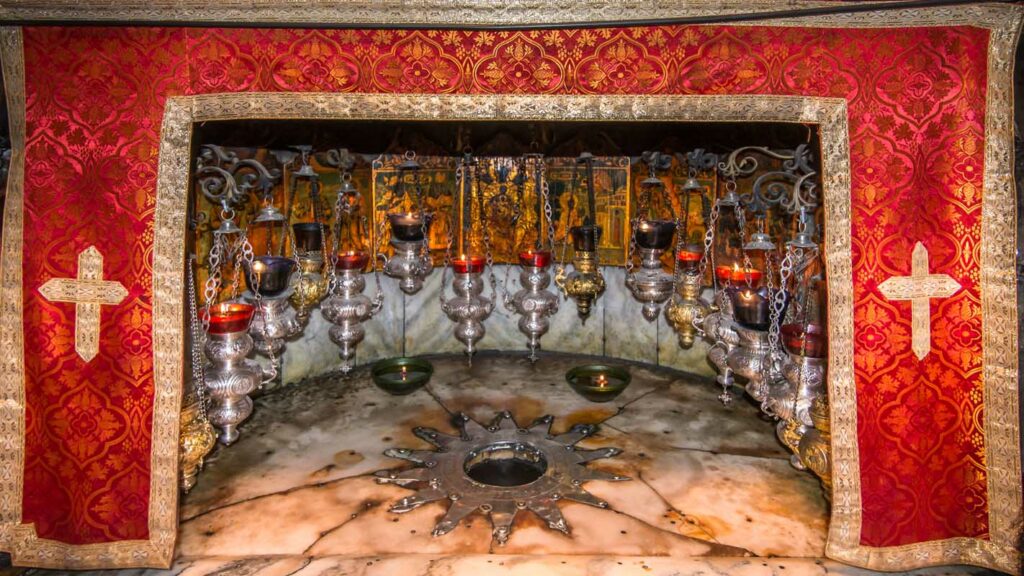
Because the oldest tradition outside the Gospels says so. Around AD 155, a Christian writer describes the birth as having taken place in a cave near the village, and other second-century sources say the same. By the middle of the next century, visitors to Bethlehem were being shown a specific cave. When Constantine’s builders raised the Church of the Nativity there, dedicated in AD 339, they built it over that cave, and the church many people visit today, rebuilt in the sixth century, still encloses it.
The cave tradition and the house tradition sit together more comfortably than they first appear. Bethlehem is built on limestone honeycombed with caves, and houses in the region were routinely built against them, using the cave as the lower level where animals were kept. A cave and a house were frequently the same building.
Where the barn came from
The freestanding wooden stable is a northern European contribution. Artists paint the world they know, and in Germany, England, and the Low Countries a place where animals are kept is a timber barn standing apart from the house. Those paintings shaped centuries of Christmas imagery, and the imagery shaped how we read the verse. The innkeeper is a later addition still, invented to fill a gap in the story that the text leaves empty.
Why the correction is worth making
Some pilgrims hear all this and feel a small loss, as though something has been taken from Christmas. My experience runs the other way.
The revised picture places the birth inside an ordinary crowded home, among family, in the room where the household ate and slept and kept its animals. The Son of God entered the world in the most common setting available in that village, surrounded by people rather than shut out by them. Jesus was laid where the animals feed, which is a detail Luke chose to record and repeat, and which the shepherds are given as the sign by which they will know Him.
Keep the nativity set on the mantel. It is a piece of art from a particular time and place, and it has carried this story faithfully for generations. Just know what the text says underneath it, because what the text says is better.
Come and See
What did a Bethlehem home actually look like then, and how does that change the Christmas you picture?
Let us rebuild that night together.
| Explore Upcoming Departures | Prepare To Be A Pilgrim |
 |

Sources and Further Reading
- Justin Martyr, Dialogue with Trypho, chapter 78 (c. AD 155–160).
- Jodi Magness, The Archaeology of the Holy Land: From the Destruction of Solomon’s Temple to the Muslim Conquest (Cambridge University Press, 2012).
- Jerome Murphy-O’Connor, The Holy Land: An Oxford Archaeological Guide from Earliest Times to 1700, 5th ed. (Oxford University Press, 2008).
