

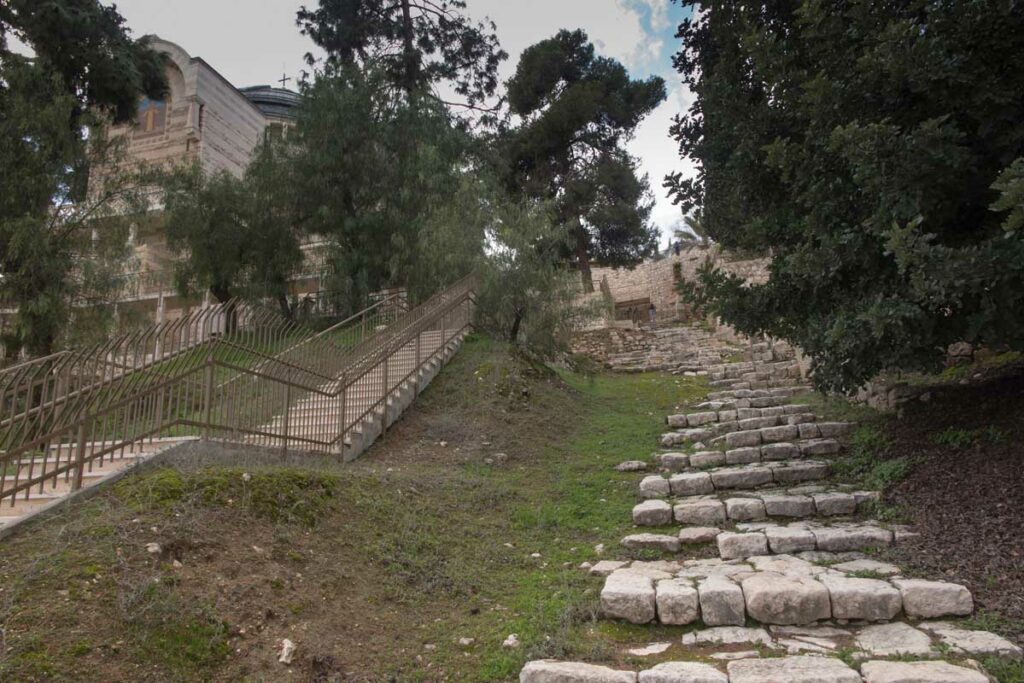
Two churches on Mount Zion claim the site of the high priest’s house. One of them stands beside a staircase that Jesus almost certainly climbed.
Most groups visit the Church of St. Peter in Gallicantu, on the eastern slope of Mount Zion, and are told this is where Caiaphas questioned Jesus and where Peter denied Him three times before the rooster crowed. The Latin name means Peter of the cock crow. Fewer groups are told that a second site on the same hill has claimed the same event for centuries, or that the strongest thing at Gallicantu may be the staircase outside rather than anything under the church.
What the Gospels describe
After the arrest in Gethsemane, Jesus is taken to the high priest’s residence. Matthew names the man: “And they that had laid hold on Jesus led him away to Caiaphas the high priest, where the scribes and the elders were assembled” (Matthew 26:57). Peter follows at a distance, sits in the courtyard with the servants, and there denies knowing Him. The courtyard has a fire, a gate, and enough traffic that a servant girl can look him over twice.
So we are looking for a substantial house with an outer courtyard, in Jerusalem, belonging to the most powerful priestly family of the day.
St. Peter in Gallicantu and the Armenian site
The Church of St. Peter in Gallicantu sits partway down the eastern slope of the hill, above the Kidron valley. The present building dates from 1931 and stands over earlier remains. Excavations there uncovered a cistern, a grain mill, storage chambers, and servants’ quarters, along with a set of weights and measures of the kind used for temple offerings, and a door lintel inscribed with the Hebrew word for a sacrificial offering. Beneath the church is a rock-cut pit, reached by a hole in its ceiling, which is shown as the cell where Jesus was held overnight.
The second candidate belongs to the Armenian church and sits higher up, near the summit of the hill by the Dormition Abbey. It has claimed the house of Caiaphas since the medieval period. Very little of it is accessible, and no substantial excavation supports it.
Our earliest witness is a pilgrim who came from Bordeaux in AD 333 and described passing the house of the priest Caiaphas while going up from the Pool of Siloam toward Mount Zion. That is a genuinely early reference, and it fits the eastern slope route well. It also stops just short of telling us which building he meant.
The argument that keeps the question open
Here is the objection that serious scholars raise about Gallicantu, and it is a good one. Caiaphas was the high priest, appointed by Rome, head of the wealthiest and most powerful family in the city. Men like that lived in the Upper City, on top of the western hill, in mansions overlooking the temple. We can see those houses today: the excavated Herodian Quarter includes a palatial mansion with a great hall, ritual baths, and imported luxury goods, exactly the sort of residence an aristocratic priestly family occupied.
Gallicantu is partway down the slope, below that quarter. Some scholars argue that the high priest’s house belongs on the summit, which favors the Armenian site or the neighborhood around it. Others answer that the Crusader period is when the summit claim first appears, and that the earlier tradition and the physical remains both point to the eastern slope. The question stays open.
What we can confirm about the man
While the address is uncertain, Caiaphas himself is one of the best-attested figures of the Gospel accounts. In 1990, construction work south of Jerusalem broke into a burial cave containing ossuaries, the limestone boxes in which Jewish families of that era gathered the bones of their dead a year after burial. One of them is unusually ornate, and it carries an inscription naming Joseph son of Caiaphas. Most scholars connect it with the high priest of the Gospels. A second ossuary, published later, names a granddaughter and identifies the family’s priestly division.
We may still be arguing about which slope his house stood on. His bone box is on display in the Israel Museum, a twenty-minute drive away.
The first-century stepped street beside Gallicantu
Now for the reason I keep this stop on the itinerary regardless of how the church debate resolves.
Beside the church runs an ancient stepped street, cut and paved, descending the slope toward the Kidron valley and the Pool of Siloam below. It is genuinely old, and it was one of the main routes between the upper city and the valley floor.
Trace the night on those steps. The supper was held in the upper city. Gethsemane lies across the Kidron on the far slope. Anyone walking from one to the other would have descended this way, and anyone brought back under arrest would have climbed it. Whether or not Caiaphas lived in the building above, the Savior walked this staircase, likely twice, on the last night before the trial.
And incidentally, the rock-cut pit at the bottom of St. Peter in Gallicantu is a beautiful location to visit and enter to ponder Jesus being placed there during his nighttime arrest. If you do, definitely read from Psalm 88. Consider those words as representing the experience of Jesus so long ago.
Come and See
Why do pilgrims come to this hillside to remember a night of denial?
Go down to the prison with us.
| Explore Upcoming Departures | Prepare To Be A Pilgrim |
 |

Sources and Further Reading
- Shimon Gibson, The Final Days of Jesus: The Archaeological Evidence (HarperOne, 2009).
- Jerome Murphy-O’Connor, The Holy Land: An Oxford Archaeological Guide from Earliest Times to 1700, 5th ed. (Oxford University Press, 2008).
