

Three serious proposals put the Holy of Holies in three different places on the same platform. No one can dig to settle it. Here is what each side is reading.
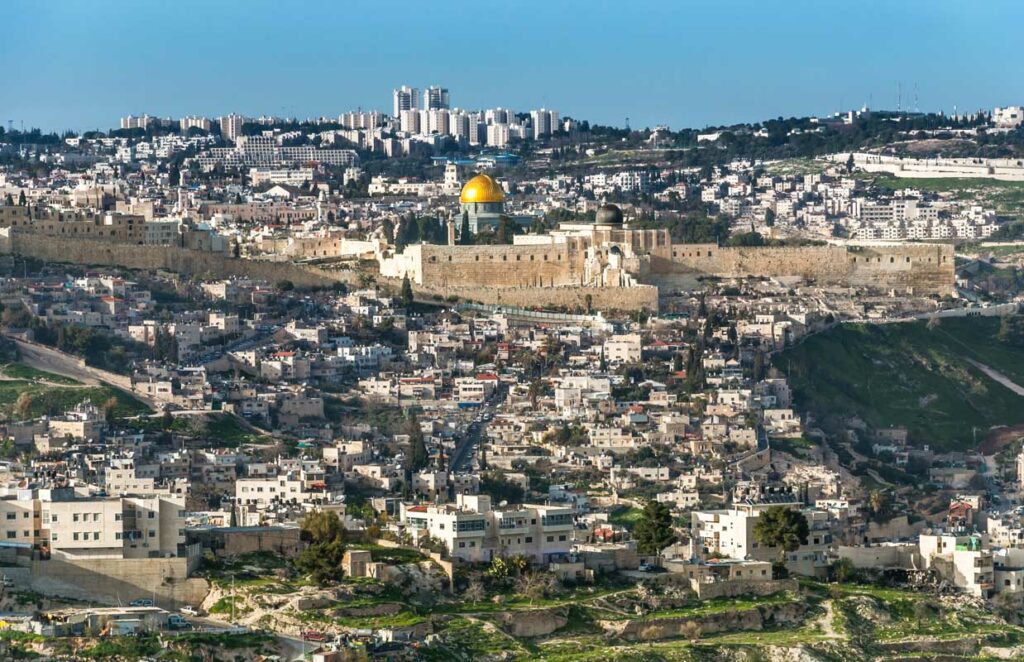
Stand on the Mount of Olives at sunrise and the platform lies open in front of you: thirty-five acres of paving, the golden Dome of the Rock near the center, the silver dome of al-Aqsa to the south, cypress trees and open plaza between them. Somewhere on that surface stood Solomon’s temple, and after it the rebuilt temple that Herod enlarged into one of the wonders of the ancient world.
Somewhere is doing a lot of work in that sentence. Ask three qualified people where the Holy of Holies stood and you can get three different answers, each argued at length.
Why the question stays open
One fact governs everything: no archaeological excavation has ever been permitted on the platform. It is among the most contested pieces of ground on earth, holy to Jews and to Muslims, administered under arrangements that took decades to negotiate. Digging there is politically impossible and likely to stay that way.
So the work is done from outside. Scholars measure the surviving walls, study the underground cisterns mapped by British surveyors in the 1860s, read the descriptions in Josephus and in rabbinic sources, trace the bedrock levels beneath the paving, and reason from where the gates and tunnels enter. Every proposal below is built from that indirect evidence.
The traditional location: under the Dome of the Rock
Most scholars, and most rabbinic authority, place the temple where the Dome of the Rock now stands. The shrine is built over a large outcrop of natural bedrock, the highest point on the platform, and the reasoning is that such an outcrop is exactly what a sanctuary would be built upon, and exactly what a later shrine would be built to cover.
The most detailed version of this case comes from an architect who spent years measuring the platform. He argues that traces of the original square enclosure described in early Jewish sources are still visible in the walls, and he reads a rectangular cutting in the surface of the bedrock as the socket where the Ark of the Covenant rested. On this reconstruction, the Holy of Holies sat directly over the rock now enclosed by the Dome.
The strength of this view is its simplicity. It uses the most prominent natural feature on the platform, it agrees with long tradition, and it fits the general alignment of the surviving Herodian walls.
The northern proposal
In 1983 a physicist published a case for a location well north of the Dome, under a small open canopy called the Dome of the Spirits, also known as the Dome of the Tablets. Both names hint at an old association with the temple. Beneath that canopy is a flat piece of stone, and the argument is that this, rather than the great outcrop, marks the Holy of Holies.
The proposal draws on measurements from rabbinic descriptions, the position of an eastern gate, and sight lines from the Mount of Olives used in temple ritual. It has attracted serious attention for forty years.
It also draws serious objections. Critics argue that the stone under that canopy is paving rather than natural bedrock, sitting several feet above the true rock surface. Others point out that a temple placed that far north would sit uncomfortably close to the defensive ditch cut across the platform’s northern edge, and that the reconstruction pushes the surrounding courts past the documented edges of the platform.
The southern proposal
A third case, argued most fully by a Tel Aviv architect, puts the temple south of the Dome, with the Holy of Holies near the ablution fountain between the Dome and al-Aqsa. A nineteenth-century scholar had suggested something similar as early as 1878.
The southern case rests largely on elevations. Early sources describe how much higher the temple stood than the gates that entered from the south, and the numbers work more comfortably for a lower, more southerly building than for one atop the highest rock on the platform. Supporters also point to the route of the aqueduct that brought water to the temple from the hills near Bethlehem, arguing that water could not have been delivered to the higher elevation the traditional view requires.
Critics answer that ancient measurements are approximate, that the platform’s surface has been reworked many times, and that this reconstruction requires setting aside the natural rock outcrop that any builder would have used.
Which Temple Mount location the evidence favors
The traditional location under the Dome of the Rock has the widest support and the fewest difficulties, and if you want one answer to carry home, that is the one the evidence favors. It is the strongest reading of indirect evidence, gathered by people who are forbidden to test it by digging.
I find this question clarifying rather than frustrating. It is a working demonstration of how historical knowledge behaves. Careful people, reading the same walls and the same texts, reach different conclusions, and the disagreement gets refined rather than resolved. That is what most historical questions look like from the inside.
It also puts the platform in proportion. Whichever reconstruction is right, all three place the sanctuary within a couple of hundred yards of one another, on a platform we can walk across in ten minutes. The uncertainty is real and it is small.
But the sanctity and significance is real. So are the lasting memories you will create when you visit.
Come and See
Why did the location of the temple matter so much to the people who worshipped there?
We will consider that together in Jerusalem.
| Explore Upcoming Departures | Prepare To Be A Pilgrim |
 |

Sources and Further Reading
- Asher S. Kaufman, “Where the Ancient Temple of Jerusalem Stood,” Biblical Archaeology Review 9, no. 2 (March/April 1983).
- Leen Ritmeyer, The Quest: Revealing the Temple Mount in Jerusalem (Carta, 2006).
